
TL;DR: A motion-triggered barking device may discourage an opportunistic approach, but direct trials of fake barking devices are lacking. Australian research found dogs deterred 61.4% of interviewed burglars and working alarms deterred 49.1%. Treat barking as an early warning cue alongside strong locks, lighting and, where useful, a camera or monitored alarm.

Do fake dog barking devices work?
They can add uncertainty and attention at an entry point, especially when barking starts only after someone approaches. However, no Australian study located for this review directly tested recorded barking devices against break-ins. The honest conclusion is “plausible deterrent”, not guaranteed protection, and the device should sit within a layered setup.
The intended mechanism is simple: a visitor crosses the detection zone, barking starts inside, and the property no longer seems silent or obviously empty. That reactive cue is more believable than a fixed recording because it appears connected to the visitor’s movement. Our related guide explains the broader evidence on whether barking dog alarms work.
What does Australian evidence actually show?
The strongest relevant Australian evidence supports dogs, working alarms and visible occupancy cues—not fake barking devices specifically. In an Australian Institute of Criminology study, 61.4% of interviewed active burglars identified a dog as a deterrent, while 49.1% identified a working alarm system. Those findings support the concept, but only by inference.
The same study reported lower deterrence figures for sensor lights (22.8%), lights inside the house (19.3%), grilled windows or doors (19.0%) and gates (12.3%). These are not product effectiveness rates. They are the shares of interviewees who named each feature when discussing what would discourage them from targeting a property.
The limitation matters. The research involved DUMA detainees in Western Australia and excluded juvenile offenders, so it is not a universal prediction. Interviewees also recognised fake alarms and cameras; a mechanical device may therefore lose credibility.
The ABS Crime Victimisation 2024–25 release estimated 196,600 households (1.8%) experienced a break-in and 217,500 (2.0%) an attempted break-in. Of the most recent completed incidents, 69% involved theft, 44% property damage and 12% confrontation.
Fake dog barking device types
Four common designs appear similar in search results but behave differently at home. The important distinction is whether the sound reacts to approach, whether the sensor can cover the right path, and whether daily control is practical. A low price is poor value if the device cannot trigger at the intended entry.
| Type | How it triggers | Best fit | Main trade-off |
|---|---|---|---|
| Looped sound box | Timer, button or continuous playback | Novelty use | Repetition is easier to recognise |
| Single-unit radar sensor | Motion sensed near the speaker | One compact doorway | Speaker position controls the detection zone |
| Separate sensor and receiver | External approach sensor triggers an indoor speaker | Paths, gates, garages and sheds | Requires two suitable mounting or resting points |
| App routine | Smart sensor or automation | Connected homes | Depends on network and compatible devices |
For an offline setup, compare power and radio range. Our no-Wi-Fi home security guide explains the benefits and missing remote-alert features.
What makes a fake dog barking sensor convincing?
A convincing sensor reacts promptly, sounds clear through the entry, avoids obvious looping and can be armed without disrupting normal household movement. Sound realism alone is not enough. The detector, speaker position, reset behaviour, false-trigger control and power arrangement determine whether the device remains credible after the first day.
- Reactive triggering: barking should start on approach, not after someone reaches the door.
- Separate placement: a wireless sensor and indoor receiver provide more flexibility than one combined box.
- Considerate volume: test outside with the entry closed. Excess volume can distort or disturb neighbours.
- Natural reset: identical clips at identical intervals sound mechanical; variation is less predictable.
- False-trigger control: aim away from footpaths, traffic, foliage, pets and heat sources.
- Daily control: a remote or accessible switch makes regular arming more likely.
Timed lights, collected mail and ordinary household sound can support the same cue. See how to make a property sound like someone is home.
Where should you place the sensor?
Place the sensor where a person commits to the approach, while keeping the speaker indoors and audible through the relevant wall or door. The ideal zone is narrow enough to avoid passers-by but early enough that barking starts before contact with a handle, window, gate or roller door.
| Location | Sensor position | Receiver position | Watch for |
|---|---|---|---|
| Front entry | Private path or porch approach | Inside near the entry | Public footpath movement |
| Side gate | Inside the boundary, facing the route | Inside the closest room | Foliage, pets and rain exposure |
| Garage or shed | Approach to the access door | Dry, protected interior position | Vehicles and metal surfaces affecting detection or range |
| Apartment | Private landing only, if building rules allow | Inside the front door | Neighbours and common-area traffic |
A shed alarm needs weather protection; a garage alarm without Wi-Fi may need extra radio range; and an apartment alarm must respect strata rules and shared spaces.
Victoria Police advice emphasises securing property and valuables, making the home look occupied, and making unseen entry harder. It recommends locks on access points, sensor lighting and reduced concealment. Barking can complement those steps.
A practical five-step setup test
A useful setup should pass five checks before you rely on it: outside audibility, early triggering, controlled false alarms, believable repeat behaviour and dependable power. Run the test in real conditions with the entry closed. Re-check after moving furniture, changing seasons or adjusting the sensor angle.
- Listen outside. Have another person activate it. The bark should be clear without distortion or needless neighbour disturbance.
- Walk the route. Approach normally from likely directions and adjust until barking starts before entry contact.
- Observe for 24 hours. Note triggers from residents, pets, deliveries, trees and traffic; narrow the zone if needed.
- Repeat the approach. Check run time, reset speed and whether the pattern becomes obviously identical.
- Check power and control. Test the remote and schedule battery or function checks.
For pairing, positioning and testing a separate sensor and receiver, use the K9-Alert setup guide. Other models may use different controls and detection technology.
When is a barking device worth buying?
It is most useful when the main goal is an immediate, local deterrent at a quiet entry and you do not need remote monitoring. The ABS estimated more households experienced attempted break-ins than completed break-ins in 2024–25, which makes the pre-entry decision point relevant—but still does not prove a bark caused any attempt to stop.
More likely to suit
- A front door, side gate, garage, shed or rental looks silent when nobody is home.
- You want a portable sound cue without a cloud account or subscription.
- You can place the sensor on a controlled approach rather than a busy public path.
- You already have sound locks and want another early layer.
Choose another priority first
- A door, window or gate is easy to force or routinely left unlocked.
- You need emergency response, phone alerts, monitoring or video evidence.
- The only sensor position would trigger constantly from neighbours, traffic or pets.
- Residents, pets or neighbours would be distressed by repeated barking.
NSW Police guidance recommends locks, perimeter lighting, trimmed concealment and secured gates. On a limited budget, repair a weak entry first.
How purpose-built devices compare
Compare products by trigger behaviour and site fit rather than by the number of sound effects. A separate approach sensor, indoor receiver, adjustable volume and convenient arm/disarm control can make a system easier to position and use. App alerts, cameras and monitoring are separate capabilities and should not be implied when absent.
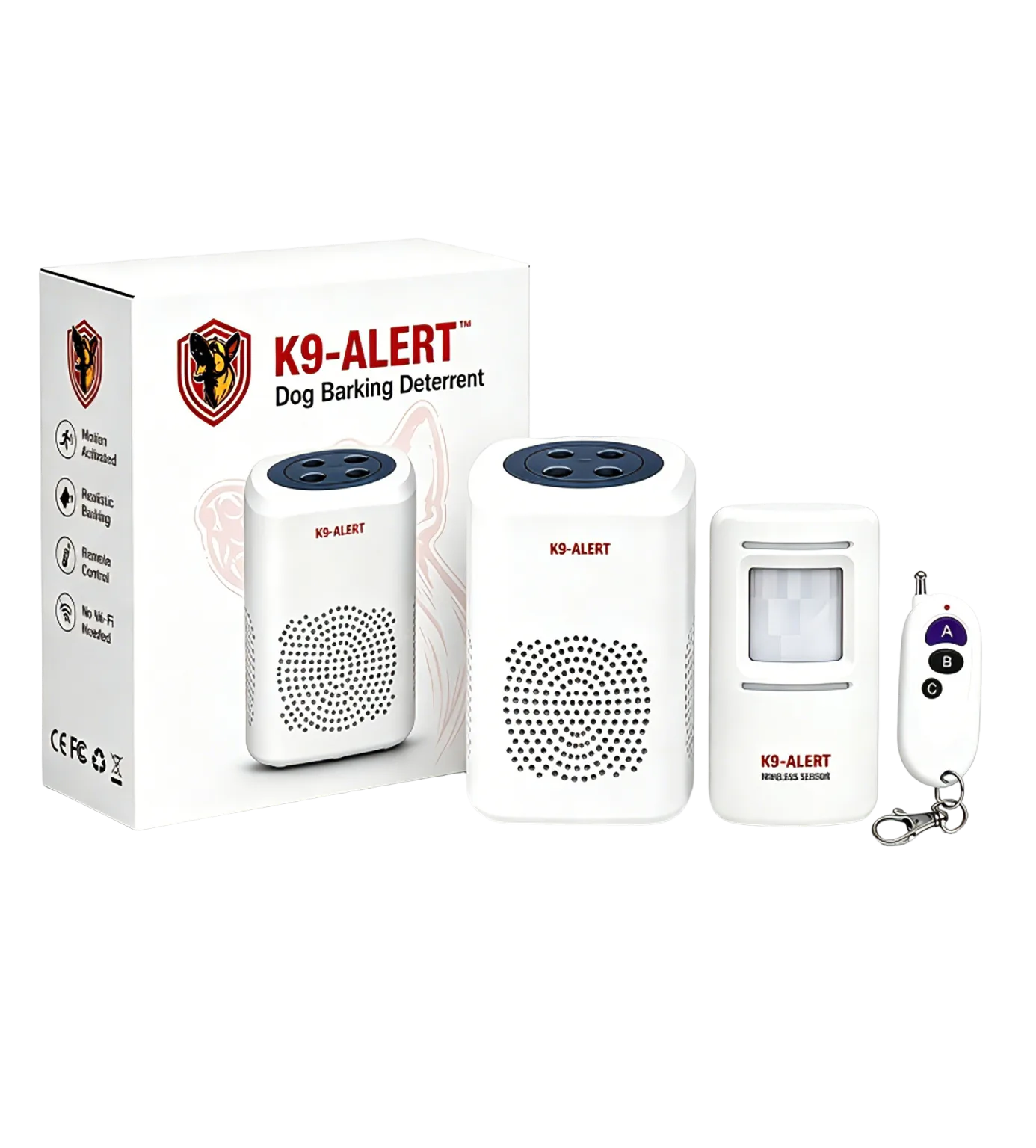
How K9-Alert fits these criteria
K9-Alert is our product. It uses a separate wireless motion sensor and indoor receiver, with adjustable volume and remote arm/disarm. It works locally without Wi-Fi, an app or a subscription, but it does not send phone alerts, record video or contact a monitoring centre.
- Best fit: a controlled home, garage, shed or rental approach.
- Price: A$99.95 with free Australian shipping at the time of this update.
- Purchase terms: 30-day money-back guarantee and 1-year warranty.
What are the honest limits?
A fake dog barking device cannot guarantee deterrence, physically resist entry, verify who is outside, record evidence or summon help. Its effect depends on the visitor, sound, timing and environment. Official evidence about real dogs and alarms supports a cautious hypothesis, not a direct claim that recorded barking prevents a specific percentage of burglaries.
- No direct efficacy rate: 61.4% concerns real dogs named by interviewees, not device success.
- No physical protection: locks, frames, gates and window hardware still delay entry.
- No evidence or response: add a camera or monitored service if needed.
- Credibility can fade: a tinny loop or late trigger may reveal the device.
- False triggers cost trust: frequent barking can disturb people and pets.
- Exposure matters: follow the manufacturer’s weather and placement instructions.
Compare barking alarms with cameras, or read our alarm versus real dog guide for responsibility, training and welfare differences.
Frequently asked questions
These short answers cover the questions buyers most often need resolved: whether the evidence is direct, what the sensor does, how realism changes, where to place it and how barking compares with cameras. Product specifications vary, so confirm the trigger, power, weather rating and return terms for the exact model before buying.
Do fake dog barking devices actually deter burglars?
They may deter an opportunistic approach by making a property sound occupied, but no Australian study located for this review directly measured fake barking devices. AIC research found 61.4% of interviewed active burglars named a dog as a deterrent. That supports the idea indirectly, not a guaranteed result for a speaker.
What is a fake dog barking sensor?
It is an alarm that plays recorded dog barking after detecting movement. Some products combine the detector and speaker; others use a separate wireless sensor outside the entry zone and a receiver inside. The separate design can make it easier to trigger before someone reaches the door while keeping the speaker protected.
Can someone tell the barking is fake?
Possibly. Repeated identical clips, weak speakers, late triggering and obvious timing patterns can reveal a recording. A reactive device is more credible when barking begins as the person approaches and can be heard naturally through the entry. Even a realistic system should be treated as one deterrent layer, not a bluff to rely on alone.
Where should I place a fake dog barking device?
Place the sensor on the private approach to the front door, side gate, garage, shed or apartment entry, and keep the receiver indoors where the bark remains audible outside. Avoid public footpaths, traffic and moving foliage. Test the full route so activation occurs before the visitor reaches a door or window.
Is a fake dog barking device better than a security camera?
Neither is universally better. A barking device creates an immediate sound cue but normally provides no footage or remote alert. A camera can provide awareness and evidence, yet may not produce a convincing occupied-home response. Where budget and privacy allow, secure locks plus appropriate sound and video layers cover different jobs.
Can you hear the barking device before choosing?
Yes—listen to a real demonstration before buying whenever one is available, preferably through headphones and then an ordinary phone speaker. A video cannot reproduce exactly how the device will sound through your own door or wall, but it can reveal the bark pattern, speaker character and triggering sequence.
Which sources support this guide?
We prioritised Australian government and policing sources that readers can inspect directly. The AIC supports statements about interviewees’ deterrent preferences; the ABS describes household victimisation; and police pages support layered prevention actions. None of these sources endorses K9-Alert or establishes a direct effectiveness rate for fake barking devices.
- Australian Institute of Criminology — offender decision study: interviews, deterrent percentages and limitations.
- Australian Bureau of Statistics — Crime Victimisation 2024–25: household break-in estimates.
- Victoria Police — Preventing home burglaries: occupancy cues, lighting and access points.
- NSW Police — Residential security: locks, gates, lighting and concealment.