
Quick answer: Yes, barking dog alarms can deter opportunistic burglars when the sensor triggers before someone reaches the entry point. AIC research found dogs deterred 61.4% of interviewed burglars and working alarms deterred 49.1%; a bark sensor borrows that dog cue, but it still needs locks, lighting and cameras around it.

How do burglars actually choose a target?
Many residential break-ins are fast and opportunistic. An intruder walks or drives through an area, looks for the easiest, lowest-risk target, and avoids anything that suggests noise, attention or unpredictability. In an Australian Institute of Criminology study, active burglars named dogs as a stronger deterrent than working alarm systems.
This is the key insight behind a barking dog alarm. The deterrent is not the dog itself. It is the sound of a dog, and the risk that sound signals. If a burglar hears barking from inside a house, they cannot verify whether a real dog is there. From the footpath, they have no way to tell. And because their goal is to avoid risk entirely, most simply move on to an easier house. A sign alone is weaker, as the Beware of Dog sign analysis explains.
Where do barking dog alarms succeed?
A motion-activated barking dog alarm is genuinely effective in these situations:
Spontaneous approaches
The "is anyone home?" walk-up to a front or back door is exactly what a bark alarm interrupts before contact with the entry point.
Breaks the "no one home" impression
An empty driveway during the day or a dark house at night invites a closer look. A bark in response to movement breaks that impression instantly.
No wiring, no fixtures
Where you cannot install wiring, drill fixtures or keep a real pet, a plug-in or battery-powered alarm provides a deterrent with zero modification to the property.
Deterrent without the dog
Allergies, cost, travel, body corporate rules or long work hours — a barking dog alarm delivers the deterrent signal without the responsibility of a living animal. If you are wondering where to buy one locally, see barking dog alarms at Bunnings or Kmart.
For these everyday scenarios, the alarm does the one job that matters most: it makes your home a less attractive, higher-risk target than the house next door.
Where do barking dog alarms fall short?
No single device is a complete security system, and a barking dog alarm is no exception. Be realistic about these limits:
- It will not stop a determined, targeted intruder. Someone who has specifically chosen your property and knows what they want is a different threat from an opportunist. A bark alarm reduces risk; it does not eliminate it.
- It does not record evidence. If an incident does occur, an alarm gives you nothing for police or insurance. That is the job of a camera.
- Placement matters. A sensor pointed at the wrong angle, or set too far from the entry point, will not trigger when it should.
The honest conclusion: a barking dog alarm is one strong layer, not the whole wall. Used as a first line of deterrence — ideally alongside good locks, sensible lighting, and a camera if you want evidence — it is one of the most cost-effective security tools available.
Quality also varies widely between devices. Our fake dog barking devices and sensors review compares cheap looping gadgets with motion-triggered setups, so you can tell a credible deterrent from a novelty before buying.
Is a barking dog alarm better than a camera or siren?
Each common deterrent does a different job. The table below shows where a barking dog alarm fits — and where another layer makes more sense.
| Option | Best for | Main limitation |
|---|---|---|
| Barking dog alarm | Deterring an approach before entry, with a believable "occupied" cue | Needs correct placement; does not record evidence |
| Security camera | Recording evidence for police or insurance | Often reacts after entry; rarely deters on its own |
| Siren alarm | Alerting neighbours once triggered | Easy to ignore; gives no "someone's home" signal |
| Real dog | A strong, proven deterrent (the AIC found dogs deterred most active burglars) | Ongoing care, cost and training; not an option for renters or while away |
Where should you place a barking dog alarm?
Place the sensor where movement begins, not where the intruder would already be inside. The best setup makes the bark sound like it comes from an occupied room behind the protected door, garage, shed or side entry.
| Entry point | Best sensor position | Why it works |
|---|---|---|
| Front door | Aim across the porch or path, under cover | The bark starts before someone reaches the handle. |
| Garage | Cover the side door, roller-door approach or internal access path | Garages often hold tools, keys and access to the house. |
| Shed | Mount under an eave, facing the approach rather than open sky | The cue sounds before tools or bikes are within reach. |
| Rental or apartment | Use a removable, no-drill position near the entry | You add a deterrent without wiring or permanent fixtures. |
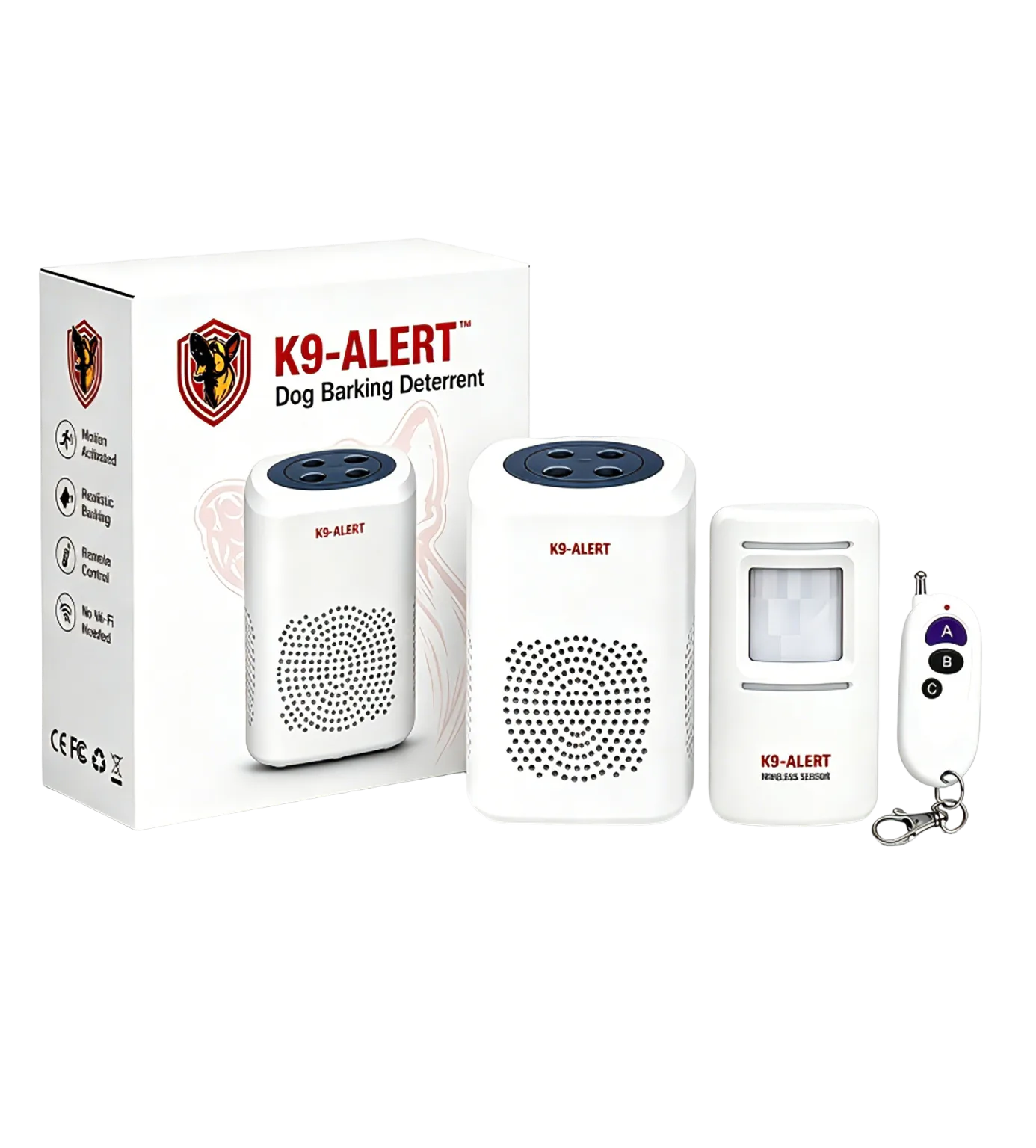
Want the bark cue without owning a dog?
K9-Alert delivers a motion-triggered dog-bark cue at the exact entry point you want to protect — no Wi-Fi, no app, no subscription and no real dog required.
- Place it where it matters: front doors, garages, sheds, side entries, rentals and shop access points.
- Control it easily: wireless motion sensor, receiver and remote arm or disarm control.
- Move it as needed: shift protection when your layout or risk changes.
Which barking alarm setup matches your situation?
The right setup depends on what you are protecting. For whole-home coverage, the priority is positioning the sensor to catch movement at your main entry points — our guide to a barking dog alarm for home security walks through where to place the device for the best results.
Garages are a special case. They are often detached, poorly lit and full of valuable tools and equipment, yet they are frequently left as an afterthought. If a garage is your main concern, see our dedicated guide to garage security with a motion-activated alarm.
When should Australian homeowners use one most?
Use one most when the home is empty or quiet for long stretches. Recorded Australian burglary data shows a summer peak, with February the busiest month, and the Christmas and January holidays leave many homes empty for days (when do most break-ins happen in Australia). Set it up and test it a week before you travel, not the night you leave.
Set it up before the summer holidays.
The K9-Alert is a motion-activated barking dog alarm designed for Australian homes — no wiring, no installation, no real dog required.
View K9-Alert kit and reviewsFrequently Asked Questions
Do barking dog alarms actually deter burglars?
Yes, in most opportunistic break-in scenarios. Burglars choose the lowest-risk target available, and the sound of a dog signals unpredictability and noise. A barking dog alarm reproduces that deterrent cue without an actual dog, which is effective against the spontaneous entry attempts that make up the majority of residential break-ins.
Can a burglar tell the difference between a real dog and an alarm?
Not from outside the property. A would-be intruder hears barking through a wall or door and cannot verify whether a real dog is present. Since most burglars move on at the first sign of risk rather than investigate, the realism of the sound matters far more than whether a dog truly exists.
Are barking dog alarms better than a security camera?
They do different jobs. A camera records an incident; a barking dog alarm aims to prevent it from happening. Cameras are reactive and useful as evidence, while a bark alarm is a proactive deterrent. For the full decision guide, compare a barking dog alarm vs security camera.
Will a barking dog alarm disturb my neighbours?
Only when motion is detected, and only briefly. Unlike a real dog, the alarm does not bark at random throughout the day. It activates in response to movement near the protected area, so it stays silent the rest of the time.
Which sources support this guide?
- Victoria Police, Prevent home burglaries
- Australian Institute of Criminology, Reports of burglary by DUMA detainees in Western Australia
- Australian Bureau of Statistics, Crime Victimisation 2024-25
Can you hear the barking alarm before choosing?
Product claims are easier to judge when you can hear the device. This short demo shows the K9-Alert barking dog alarm detecting movement and playing realistic barking, so you can assess the sound before deciding where it fits in your home, garage, shed or rental.