
TL;DR: The best barking dog alarm is motion-triggered, not looping - a separate wireless sensor, a realistic large-dog bark, adjustable volume, a remote and no subscription. The Australian Institute of Criminology found 61.4% of interviewed burglars named a dog as a deterrent, ahead of working alarms at 49.1% - but only a device that reacts credibly earns that effect.

What makes a barking dog alarm actually work?
The best barking dog alarm works because it reproduces the one deterrent burglars consistently respect: a dog reacting to their approach. Australian Institute of Criminology interviews with active burglars found a dog was named as a deterrent by 61.4% of them, ahead of working alarm systems at 49.1% (AIC, Understanding Residential Burglary). The catch is that the effect depends on the bark feeling real.
That matters because the risk is genuine. In 2024-25 the ABS recorded 196,600 households (1.8%) experiencing a break-in and 217,500 (2.0%) an attempted break-in (ABS, Crime Victimisation 2024-25). Most of those attempts happen at the decision point, while someone is still weighing up whether the home is easy - which is exactly when a reactive sound has the most influence.
So the single biggest quality marker is the trigger. A bark that starts the moment someone enters a detection zone reads as a live response. A bark that loops on a timer, whether anyone is there or not, teaches the listener that no real animal is involved. Everything else - sound quality, volume, controls - is secondary to getting that reaction right.
Which barking dog alarm type should you avoid?
Most products fall into three groups, and the difference between them is bigger than the price tags suggest. Here is how they compare on the things that decide whether the deterrent holds up.
| Type | Novelty looping unit | Motion-triggered sensor unit | App / smart speaker |
|---|---|---|---|
| Trigger | Loops on a fixed timer | Wireless sensor detects approach | Manual or app schedule |
| Realism | Tinny, repetitive bark | Realistic large-dog bark, adjustable | Varies with speaker quality |
| Placement | Speaker and sensor in one box | Sensor covers the approach, receiver inside | Tied to a power point and network |
| Works offline | Usually yes | Yes - no Wi-Fi needed | No - needs Wi-Fi and often power |
| Ongoing cost | None | None - one-off purchase | Sometimes a subscription |
| Best for | Short-term novelty | Front doors, sheds, garages, rentals | Existing smart-home setups |
For most Australian homes the motion-triggered sensor unit is the sweet spot: it delivers the reactive bark that makes the deterrent credible, without depending on Wi-Fi or a monthly fee. Our review of fake dog barking devices and sensors goes deeper on why the looping type falls short, and the evidence on whether barking dog alarms work covers where the deterrent has limits.
How much should a barking dog alarm cost in Australia?
A good barking dog alarm should cost around $80 to $150 as a one-off purchase. Below that you are usually looking at a novelty looping unit; well above it you are often paying for a monitored system that does a different job. Price alone does not tell you much - what to check is whether the cost ends after you buy.
This is where a one-off deterrent has a quiet advantage over subscription security. A device you buy once and own has no second bill; a monitored plan keeps charging every month for as long as you keep it. If the upfront number is the hurdle, buy now pay later can spread it - our guide to buying a home security alarm on Afterpay explains how that works, and the no-subscription home security guide weighs buy-once against pay-monthly.
For reference, the K9-Alert kit is A$99.95, or four interest-free payments of $24.99, with no app, no Wi-Fi and no monthly fee - a one-off cost that stops once it is paid.
What to look for before you buy
Once you know the type you want, use this checklist to separate a genuine unit from a gadget. The best barking dog alarm ticks all of these, not just the first one or two.
Check for these before you buy
- Motion trigger, not a timer - the bark should start on approach, so it reads as a reaction rather than a recording.
- Separate wireless sensor - lets you cover the approach point while the speaker sits inside, which sounds more like a dog indoors.
- Realistic, adjustable volume - a deep, believable bark you can set for your door, wall and neighbour distance.
- A remote to arm and disarm - so you can actually use it day to day without tripping it yourself.
- Works without Wi-Fi or a subscription - important for sheds, rentals, rural blocks and blackout reliability.
- Australian support and a warranty - a local business, a warranty and a returns window matter more than a marketplace listing with none.
Do not overweight extra sound effects or gimmicks. A single realistic bark that triggers correctly beats a menu of ten novelty sounds that loop. Placement matters too - aim the sensor at the path someone must take to the door, not at a busy footpath or a tree that moves in the wind. Victoria Police advises securing all access points and using cues that make a home look occupied, and a reactive bark at the approach is one such cue.
Which barking dog alarm is best for your situation?
The best choice depends on what you are protecting and any constraints like renting or poor coverage. The core unit is the same - the difference is placement and how many sensors you need.
Portable, no-drill
Choose a unit that needs no fixtures and moves with you. See the best alarm for renters guide for no-drill setups.
Offline reliability
Metal walls and no Wi-Fi suit a self-contained unit. The garage alarm without Wi-Fi page covers placement.
Cover the approach
Protect the front path or driveway before the door. The barking dog alarm page shows where to aim it.
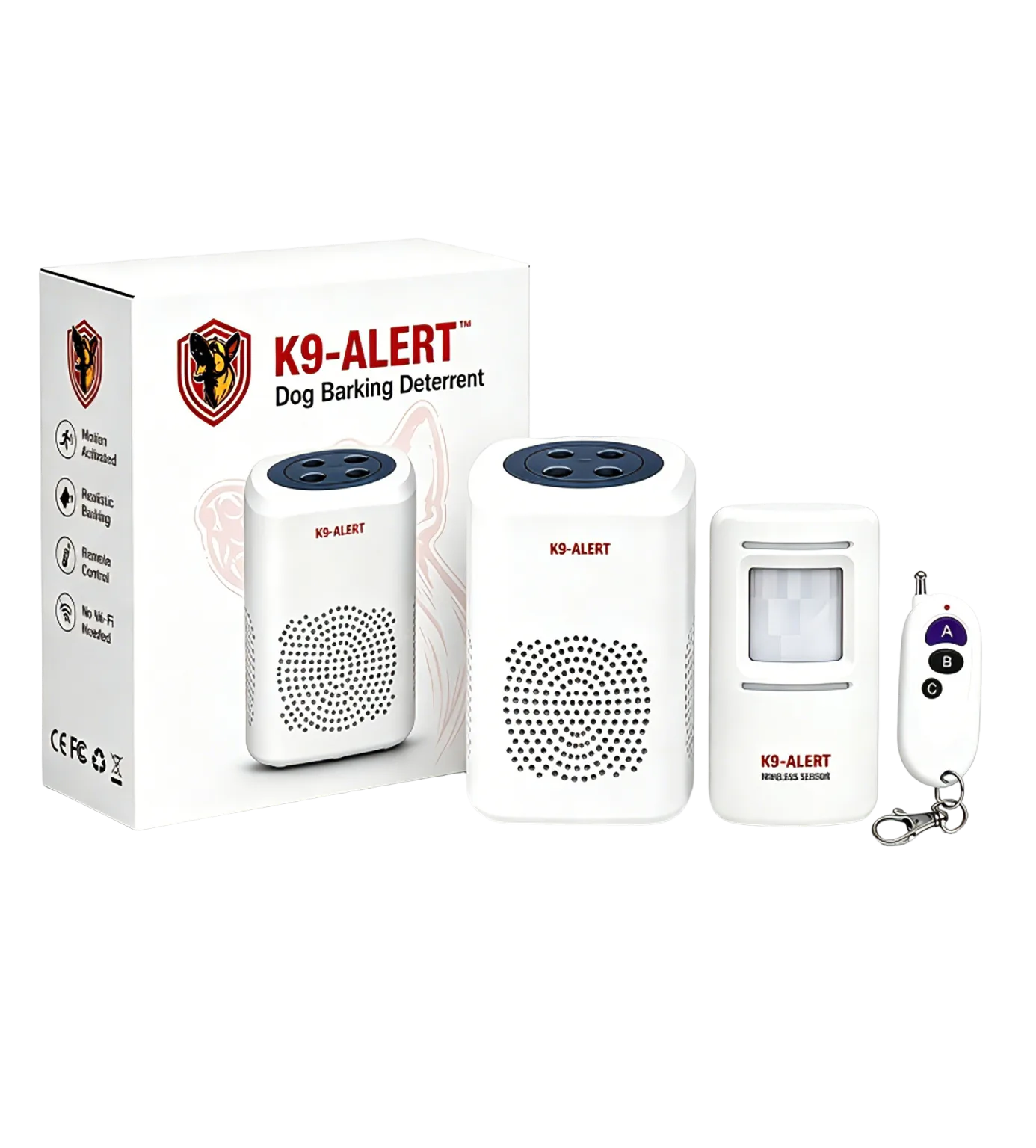
K9-Alert is the motion-triggered, no-subscription pick.
K9-Alert matches the criteria above: a separate wireless motion sensor, realistic bark modes, adjustable volume and a key-ring remote to arm, disarm and sound the SOS - with no Wi-Fi, no app and no monthly fee.
- Reacts, not loops: the bark starts when the sensor detects approach at the entry.
- Buy once: A$99.95, or four interest-free payments of $24.99 - no subscription.
- Backed locally: Australian business, 1-year warranty and a 30-day money-back guarantee.
Get the reactive bark, skip the looping novelty.
K9-Alert is a motion-triggered barking dog alarm for Australian homes, rentals, sheds and garages - A$99.95 with free AU shipping, a 30-day money-back guarantee and a 1-year warranty.
Order K9-Alert · $99.95Frequently asked questions
What is the best barking dog alarm in Australia?
The best barking dog alarm is a motion-triggered unit with a separate wireless sensor, a realistic large-dog bark, adjustable volume and a remote to arm and disarm it. Avoid novelty units that loop the same short bark on a timer, because a repeating sound is the easiest kind for someone to dismiss as fake.
How much should a good barking dog alarm cost in Australia?
Cheap looping gadgets sell for $15 to $40 but often disappoint. A quality motion-triggered unit with a separate sensor and remote typically sits around $80 to $150 as a one-off purchase. K9-Alert is A$99.95, which can be split into four interest-free payments of $24.99, with no ongoing subscription.
Do cheap barking dog alarms actually work?
Some do for a short time, but the common weakness is a tinny speaker looping one bark on a fixed timer. That pattern is easy to recognise as fake. A device that only barks when its sensor detects approach feels tied to the person's movement, which is what makes the deterrent credible.
What is the best barking dog alarm without Wi-Fi?
Look for a self-contained unit that pairs a wireless motion sensor to a receiver with no app, hub or internet connection. This suits sheds, garages, rentals and rural properties with poor coverage, and it keeps working during an NBN or power outage if it is battery-backed.