
TL;DR: Bunnings and Kmart stock generic security hardware - motion sensors, entry chimes, cameras and sensor lights - but not a dedicated motion-triggered barking-dog alarm. Those detect and announce; a barking-dog alarm deters with a realistic dog sound. Buy the barking type from a specialist Australian seller with a warranty and local support.

Can you buy a dog barking alarm at Bunnings?
Not directly. Bunnings stocks plenty of home-security hardware, but its range is detection and recording, not a barking deterrent. Its security and safety category lists PIR motion sensors, wireless doorway and entry chime alarms, plug-in alarm-system components and security cameras - useful devices, but none that plays a realistic dog bark.
The distinction matters. A doorway chime or motion sensor tells you someone is there, usually with a beep or a notification. A barking-dog alarm is aimed at the person outside, using a sound that signals an occupied home before they reach the door. Both have a place, but they are not the same purchase, and swapping one for the other leaves a gap.
That gap is worth closing because approach is where deterrence works. In 2024-25 the ABS recorded 196,600 households (1.8%) experiencing a break-in and 217,500 (2.0%) an attempted break-in (ABS, Crime Victimisation 2024-25). A chime that sounds after entry does little for the attempts; a deterrent that reacts at the approach does more.
What about Kmart, Big W or online marketplaces?
Kmart is similar but tilted toward cameras. Its home safety and security range centres on smart indoor cameras, Wi-Fi doorbell cameras, motion-sensor lights and smoke alarms - handy and cheap, but again not a dedicated barking-dog alarm. Big W and similar general retailers follow the same pattern: personal alarms, sensor lights and the odd camera, rather than a deterrent sound unit.
Online marketplaces are where "fake dog" and "barking alarm" listings do appear, imported and inexpensive. The catch is variable quality and support. Many are the looping-novelty type that repeats one bark on a timer, which is the easiest kind to recognise as fake, and a marketplace listing rarely comes with an Australian warranty or anyone to call. If you do buy online, check the return policy, look for a real motion sensor rather than a timer, and read the critical reviews rather than the star average. Our fake dog barking devices review covers how to spot the weak ones.
Generic alarm vs dedicated barking-dog alarm
The quickest way to decide is to match the device to the job. Here is how the common in-store options compare with a dedicated barking-dog alarm on the things that matter for deterrence.
| Device | What it does | Sound | Deters at approach? |
|---|---|---|---|
| Entry / doorway chime | Alerts you when a door opens or someone passes | Beep or chime | Limited - mainly notifies |
| PIR motion sensor | Sends an alert or app notification on movement | Optional siren or silent | Only if paired with a siren |
| Security camera | Records footage for evidence | None or two-way audio | Weak - records, does not deter |
| Dedicated barking-dog alarm | Plays a realistic bark when motion is detected | Large-dog bark, adjustable | Yes - occupied-home cue on approach |
The reason the barking type earns its place is the deterrent it copies. Australian Institute of Criminology interviews with active burglars found a dog was named as a deterrent by 61.4% of them, ahead of working alarm systems at 49.1% (AIC, Understanding Residential Burglary). A camera or chime does not reproduce that cue; a realistic, motion-triggered bark does.
What is worth buying in-store to go with it
A trip to the hardware or department store is not wasted - several cheap items genuinely strengthen a barking-dog alarm. They are not the deterrent itself, but they are the supporting layers that make it work harder, and both Bunnings and Kmart stock them well.
- Sensor lights - a motion light on a dark approach removes the cover an intruder wants, and pairs naturally with a sound that reacts at the same point.
- Better locks and deadbolts - the physical layer a sound can never replace. If a door or window is easy to force, harden it first.
- Timer switches - cheap plug-in timers cycle lights while you are out, adding the occupied-home cue the barking alarm reinforces.
- A doorway chime - useful inside for your own awareness of comings and goings, as long as you treat it as an alert, not a deterrent.
Layered simply, that is a strong, low-cost setup: hardened entries, light on the approach, an occupied look, and a reactive bark at the door. Our secure your home for under $200 guide sequences these in priority order so you spend on the highest-impact steps first.
Where to buy a barking dog alarm in Australia
Buy a dedicated barking-dog alarm from a specialist Australian retailer rather than a big-box store or an anonymous marketplace seller. The difference is not just the device - it is the warranty, the returns window and having someone local to help if a sensor needs pairing. A specialist seller also tends to stock the motion-triggered type by default, rather than the looping novelty units that dominate cheap listings. Before you buy, from any source, check the same short list.
Check before you buy
- Motion-triggered, not looping - the bark should start on approach, so it reads as a reaction.
- Realistic, adjustable bark - a believable large-dog sound you can set for your door and neighbours.
- Separate wireless sensor and a remote - to cover the approach and arm or disarm it easily.
- No Wi-Fi or subscription needed - so it works in sheds, rentals and blackouts.
- Australian warranty and returns - a local business beats a marketplace listing with no support.
If you want the full decision framework before you spend anything, our guide to the best barking dog alarm in Australia compares the device types in detail and lists the exact features to look for, and if the upfront cost is the hurdle, buying on Afterpay spreads it over four interest-free instalments.
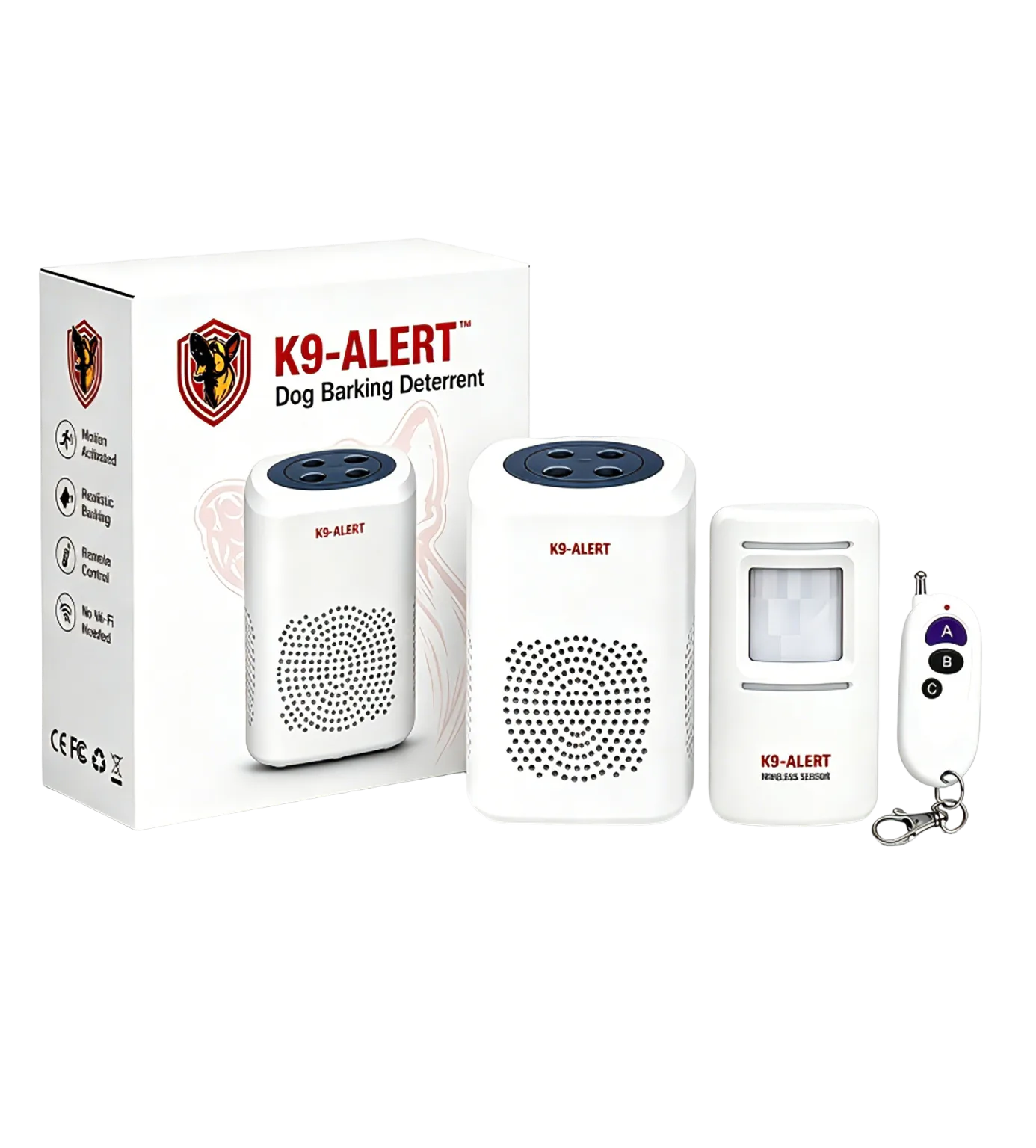
K9-Alert is the dedicated barking-dog alarm the big stores do not stock.
K9-Alert is a motion-triggered barking dog alarm bought directly from an Australian business - a separate wireless sensor, realistic bark modes, adjustable volume and a remote, with no Wi-Fi, no app and no monthly fee.
- Reacts at the approach: the bark starts when the sensor detects movement at the entry.
- Australian support: 1-year warranty and a 30-day money-back guarantee, not a marketplace listing.
- Buy once: A$99.95, or four interest-free payments of $24.99, with free AU shipping.
Skip the hardware aisle guesswork.
K9-Alert is a dedicated motion-triggered barking dog alarm for Australian homes, rentals, sheds and garages - A$99.95 with free AU shipping, a 30-day money-back guarantee and a 1-year warranty.
Order K9-Alert · $99.95Frequently asked questions
Does Bunnings sell dog barking alarms?
Bunnings stocks generic home-security hardware - PIR motion sensors, doorway and entry chime alarms, alarm-system components and cameras - but not a dedicated motion-triggered barking-dog alarm. Those play a beep or chime, not a realistic dog bark, so they detect and announce rather than deter with an occupied-home sound.
Can you buy a barking dog alarm at Kmart?
Kmart's security range centres on smart cameras, Wi-Fi doorbell cameras, motion-sensor lights and smoke alarms rather than deterrent sound devices. It is a good place for a cheap camera or sensor light, but not for a dedicated barking-dog alarm.
Where is the best place to buy a barking dog alarm in Australia?
A dedicated barking-dog alarm is usually bought from a specialist retailer that sells the motion-triggered type, rather than a big-box store. Buy from an Australian seller that offers a warranty, a returns window and local support, so you are not relying on a marketplace listing with none.
Are cheap barking dog alarms from online marketplaces any good?
Some are fine, but marketplace listings are often the looping-novelty type that repeats one bark on a timer, with variable quality and no local support. The trigger is what matters: a unit that barks only when its sensor detects approach is more convincing than one that loops regardless.