
Can one receiver handle all three sensors?
Yes. All three pair to the single receiver in the kit, and one receiver supports up to 8 sensors in total. Whichever sensor detects movement, the same receiver sounds the alert.
Barks before they reach the door, gate or shed. One K9-Alert receiver, three wireless motion sensors and a remote control.
or 4 interest-free payments of $41.24 with Afterpay — Zip also available
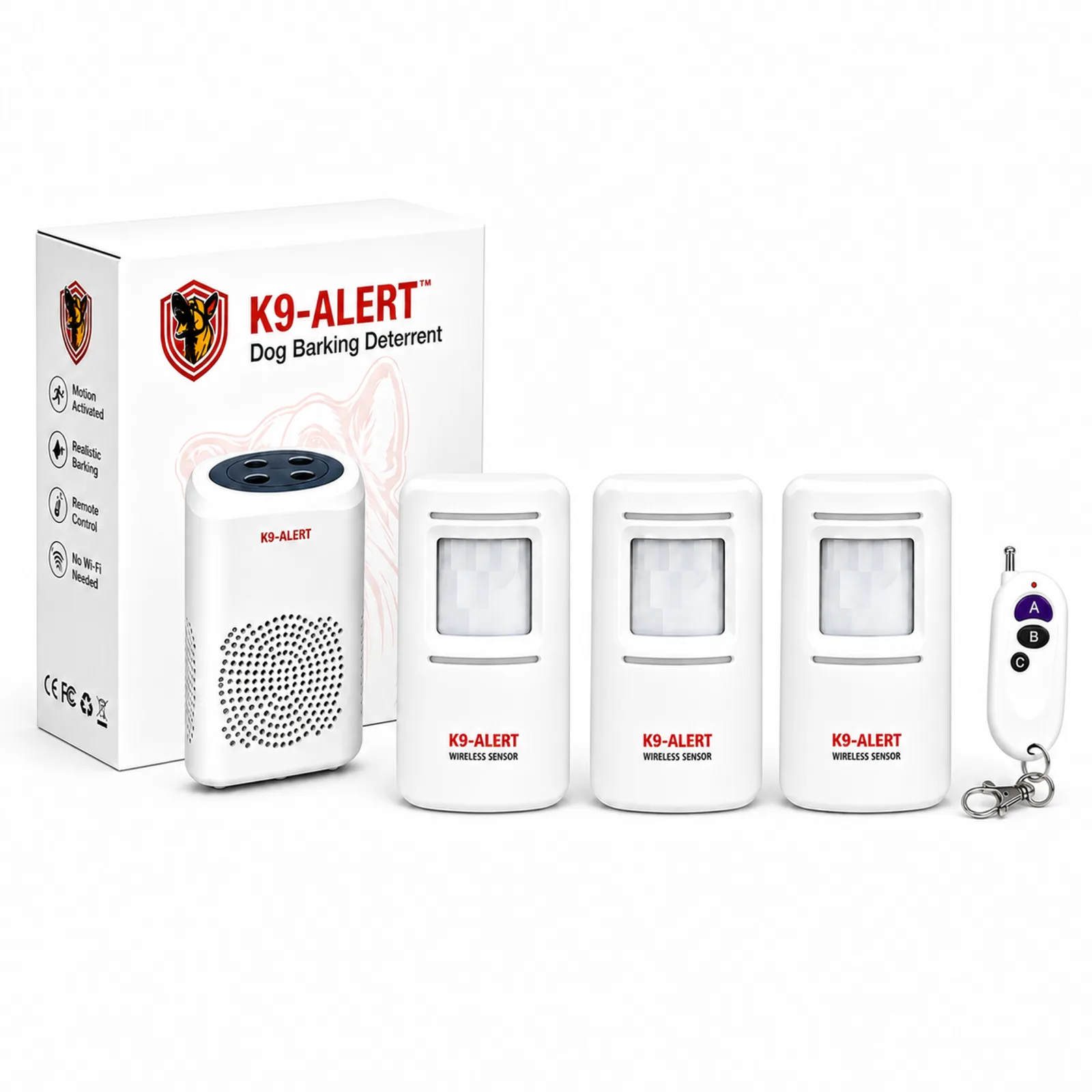
Use one sensor at the main entrance, one at the back or side approach, and one at a garage, shed, hallway or shop storage area.
Checkout opens with one kit and two extra sensors selected.
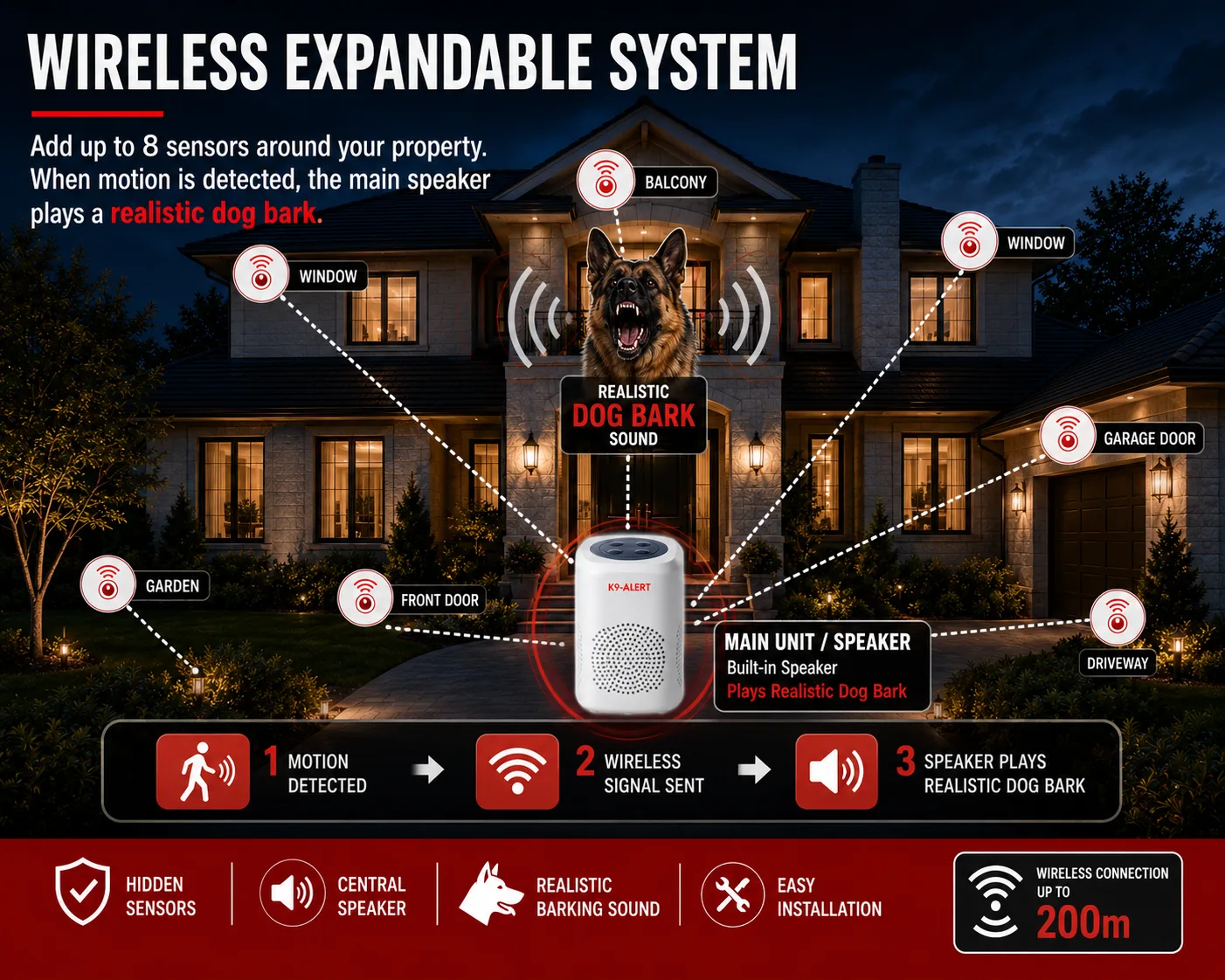
It suits a house with front, back and garage approaches, or a small business with a front door, rear access and stock area.
Three sensors only buy you three zones if they watch genuinely different approaches. Each covers roughly 0-7m across a sector of about 110 degrees, so overlapping two of them on the same path gains nothing and doubles the triggers you hear.
The front entry or the path leading to it. Aimed across the path, the barking starts while someone is still on the way in.
A side gate, garage side door or back entry. On most properties this is the approach that decides whether someone continues or leaves.
The shed door, carport, storeroom or rear boundary — the place the tools, bikes or stock sit. On a shop this is usually the rear entry rather than the shopfront.
All three sensors trigger the same receiver, so site it where the barking is audible from outside each zone you care about. If the three zones are too far apart for one sound point to cover, separate kits suit the layout better than one receiver.
Yes. All three pair to the single receiver in the kit, and one receiver supports up to 8 sensors in total. Whichever sensor detects movement, the same receiver sounds the alert.
By default the sensor shows a small red light when it detects movement. If you would rather nobody could tell the barking is coming from a device, press the TEST button on the side of the sensor once. It still detects movement and triggers the receiver, but the red light stays off.
No, and with three zones it matters more. The receiver plays the same alert whichever sensor fires, so it tells you something moved somewhere across your three zones. If you need to know which, use a kit per zone so each has its own receiver in a different room.
The manual quotes 200m wireless reception. That figure is for a clear line of sight — brick walls, a metal roller door or a detached building between sensor and receiver will cut it back, sometimes sharply. Keep every sensor on the same property as the receiver and test each one before you mount it permanently.
No. Each sensor pairs directly with the receiver, so nothing in the kit touches your router, your phone or a monthly plan. That is also why it keeps working during an internet or NBN outage.
Each sensor runs on 3 x AAA batteries or USB power, and the receiver on 4 x AA or USB. Battery power is what makes the extra zones practical: a side gate or shed door rarely has a spare power point, and the receiver can warn you when its own voltage drops.
Often, yes. If two of your three approaches funnel through the same path, a second sensor there adds triggers rather than coverage, and the 2-zone kit is the better buy. Three zones earn their keep when the approaches are genuinely separate — front, side gate and a shed or carport, for example. You can always add the third sensor later for $39.95.
No. It is a motion-triggered barking deterrent covering three approaches. It is not monitored, it does not call anyone or notify your phone, and it does not replace locks, lighting or a monitored panel. Treat it as the deterrent layer that reacts before someone reaches a door.
Only if both buildings sit within wireless reception of the one receiver and you can actually hear that receiver from both. A house-and-shed setup usually works; a house plus a separate granny flat usually does not, because nobody in the flat hears the receiver in the house. Separate kits are the honest answer for that layout.
Same receiver, sensors and remote as the 1-Zone Kit — read the 18 verified reviews & feedback, the full spec sheet and placement guide on the kit page.
Full refund of the product price within 30 days of delivery. Return postage is paid by you, the customer.
Manufacturing faults under normal use are replaced at our cost or repaired.
Dispatched from our Melbourne warehouse by RED SHIELD PTY LTD (ABN 89 691 324 268).
support@k9alert.com.au within 24 hours AEST on business days.
Free tracked AU shipping, 30-day money-back and a 1-year warranty.
Free AU shipping · 30-day money-back · 1-year warranty
Selected customer reviews, in their original wording. Feedback without a star rating is excluded from the average.
No star rating provided
Bloody awesome 👌 scares the shot out of me too, cause I forgot where I put it 😆 🤣 😂
No star rating provided
Thankyou prompt delivery
No star rating provided
Great quality product, value for money. As described. Easy transaction & pick up. Excellent seller, prompt service, friendly & very helpful. A+++++. Thank you so much 😊
No star rating provided
received barking dog alarm today thank you kind regaeds
No star rating provided
Fast delivery. Thank you.
No star rating provided
Thanks great product