
TL;DR: Victoria's recorded crime rate eased 1.9% to 8,690.8 offences per 100,000 people in the year to March 2026 - its first annual fall in almost four years - but it stays high and varies hugely by area. The City of Melbourne records the highest rate. Most home risk is opportunistic, so focus on deterring entry, not just recording it.

How crime is measured by area in Victoria
Victoria's crime data comes from the Crime Statistics Agency, the independent body that publishes what Victoria Police records each quarter. Two figures matter when you compare one area with another: the count of offences, and the rate per 100,000 residents.
The rate is the fair way to compare places, because it adjusts for population. A busy inner-city council and a small country shire will always differ on raw counts, but the rate shows how much crime happens relative to how many people live there. It is the same logic behind sensible home invasion deterrence: judge the real risk, not the headline number.
One more distinction is worth knowing. An incident is a single event reported to police, while that event can contain several offences. The area tool lets you filter by local government area, suburb or town and by offence type, so you can look up recorded incidents and the rate for your own postcode rather than relying on a statewide average.
Which Victorian areas have the highest crime rates?
In the year to March 2026 the City of Melbourne recorded the highest rate of any local government area - about 17,110 criminal incidents per 100,000 people. Inner-city Yarra and Port Phillip, plus the Gippsland council of Latrobe, follow, all well above the state incident rate of roughly 6,513 per 100,000.
| Local government area | Where it is | Criminal incidents per 100,000 | Change on the year |
|---|---|---|---|
| Melbourne (CBD) | Inner Melbourne | 17,110.1 | Down 3.7% |
| Latrobe | Gippsland (regional) | 12,922.8 | Up 4.7% |
| Yarra | Inner Melbourne | 12,312.1 | Down 4.2% |
| Port Phillip | Inner Melbourne | 10,986.9 | Up 2.1% |
| Northern Grampians | Grampians (regional) | 10,712.0 | Highest country council |
Read these as resident-based rates, not danger scores. A council can top the list because a lot happens there relative to the small number of people who sleep there, not because every household faces the same odds. The next two sections explain why that matters.
Why does the City of Melbourne top the list?
The City of Melbourne looks extreme because the rate is measured per resident, and very few people actually live in the CBD compared with the crowd that fills it. Every weekday brings hundreds of thousands of workers, students and visitors, and the nightlife draws more again after dark.
All of the theft, assault and public-order offences those visitors are involved in get divided by a small residential base, which pushes the rate far above the suburbs. It does not mean a Melbourne apartment is three times more dangerous than a house in Geelong. For a resident, the everyday risk is closer to the state average than the CBD headline suggests - though dense, busy streets do bring their own opportunistic theft.
Is regional Victoria any safer?
Not automatically. Latrobe, in the Latrobe Valley, sits second on the list and rose 4.7% over the year, while Northern Grampians was the highest-rate country council at 10,712.0 incidents per 100,000 - close to inner-Melbourne territory. Plenty of regional towns record rates above the state figure.
Distance also changes the response. In much of country Victoria a police car can be a long drive away, so the minutes before anyone arrives matter more. That is the case for deterrence-first thinking on farms and acreage, which our guide to rural property security works through in detail. A quiet postcode is a reason to stay sensible, not a reason to leave the shed and back door open.
Is Victoria's crime rate going up or down?
Both, depending on the measure. Across the state, police recorded 625,426 offences in the year to March 2026, down a slight 0.2%, while the population-adjusted rate fell 1.9% to 8,690.8 per 100,000 - the first annual fall in almost four years. Criminal incidents dropped 1.0% to 468,711.
That easing follows several years of sharp increases, so the level is still high by the standards of the past decade. The picture underneath is mixed, and the parts that affect households have not all improved:
- Theft from motor vehicles was the second-biggest offence group at 80,786, down 2% but still enormous - the everyday raid on cars parked in driveways and on the street.
- Car theft reached 31,851 vehicles stolen, the highest since 2001-02 and more than double the figure of four years ago, according to the Victoria Police release.
- Aggravated burglaries - the break-ins where someone is home or is confronted - fell 19.9% over the year, but remain well above where they sat a few years ago.
Police point to sustained pressure on repeat offenders. Operation Trinity, Victoria Police's largest effort against home burglaries, led to 523 burglars being arrested a combined 1,098 times in the last year. Enforcement helps, but it works on the people already offending, not on how easy your home looks tonight.
What do the area numbers mean for your home?
The area rate is your background risk. Your personal risk is driven by something the tables cannot see: how easy your home looks to approach and enter. The biggest categories in the data - vehicle theft, theft from cars, and burglary - are overwhelmingly opportunistic, chosen for a soft target rather than a specific address.
Nationally the pattern is the same. The ABS counted 196,600 household break-ins and a further 217,500 attempted break-ins across Australia in 2024-25 (ABS Crime Victimisation 2024-25). Most start with someone testing whether a home is empty, unlit or unlocked. That is also why so many burglaries begin at the car and keys rather than the television, a link we unpack in why thieves target your keys.
So the useful question is not only "what is my suburb's rate" but "does my home look occupied and hard to approach". If you were recently targeted, our guide on whether burglars come back covers the repeat-risk window. For everyone else, the steps below lower risk in a high-rate CBD and a quiet regional town alike.
How to lower your risk wherever you live
Deterrence works on the choice a would-be intruder makes in the first few seconds - before a lock is ever tested. Work through these in order; none depends on your postcode or on Wi-Fi.
Whatever your area's rate, start here
- Do make the home look and sound occupied. Use timers on lights and a sound cue at the entry. Do not leave the house dark, silent and obviously empty for long stretches.
- Do move car keys away from the front door and out of sight. Do not leave keys, bags or devices on a hall table visible through the glass.
- Do secure the second entry points - side gate, garage internal door, laundry and windows. Do not assume a locked front door is the whole job.
- Do add motion lighting to dark approaches and the driveway. Do not rely on a single sensor light a person can simply step around.
- Do put a motion-triggered deterrent at the main approach so anyone reaching it is met with a sign of life. Do not wait for a full installed system before covering the obvious gap.
- Do meet a neighbour who will notice an unfamiliar car. Do not broadcast holidays or big deliveries on public social feeds.
If you want the full low-cost sequence, our under-$200 home security plan puts these in priority order, and the home security overview shows how the layers fit together.
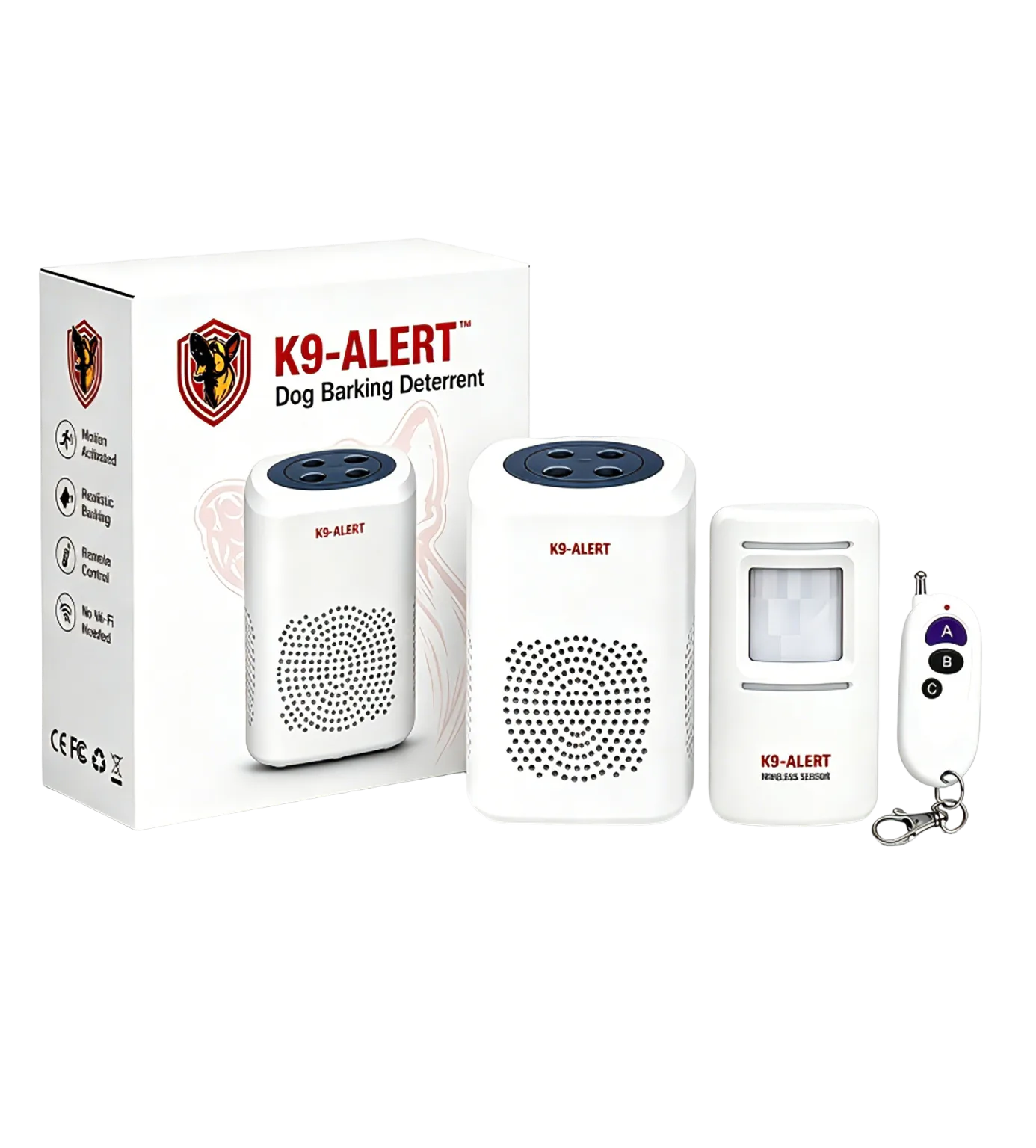
Meet an approach with a sign of life - before a door is tested.
K9-Alert is a motion-triggered barking dog alarm that reacts the moment someone reaches a door, gate or driveway. It targets exactly the opportunistic approach the Victorian data is full of - no Wi-Fi, no app and no monthly fee.
- Works anywhere: a CBD apartment, an outer-suburb house or a regional block - it does not need the NBN.
- No installation: plug in the receiver, place the wireless sensor and arm it in minutes.
- Layer it: add extra sensors for a garage, side gate or shed as a second and third zone.
A deterrent does not replace good locks, sensible habits, insurance or the police - it lowers the chance your home is the one chosen in the first place. It sits alongside the hardening steps above, and it is most useful during the empty hours when a house is quiet and unlit.
Cover the entry point that decides most break-ins.
K9-Alert sets up in minutes with no Wi-Fi, no wiring and no subscription - the same barking cue in a high-rate suburb or a quiet country street.
Order K9-Alert · $99.95Frequently asked questions
What is the crime rate in Victoria right now?
In the year to March 2026 Victoria Police recorded 625,426 offences, a rate of 8,690.8 per 100,000 people. That was down 1.9% on the year, the first fall in almost four years, but it is still one of the higher rates recorded over the past decade.
Which area has the highest crime rate in Victoria?
The City of Melbourne, at about 17,110 criminal incidents per 100,000 people in the year to March 2026. Its rate is lifted by a small residential population and a large daytime and night-time crowd of workers, students and visitors, so it overstates the risk to a typical resident.
How do I check the crime rate for my suburb?
Use the Crime Statistics Agency latest crime data by area tool. You can filter by local government area, suburb or town and by offence type to see recorded incidents and the rate per 100,000 people for your own postcode.
Does a lower-crime area mean my home is safe?
No. Area figures are background context, not a guarantee. Most home break-ins and vehicle thefts are opportunistic, so an easy-looking house in a quiet suburb can still be targeted. How your home looks and sounds on approach matters more than the council average.
Can a barking dog alarm help in a higher-crime area?
It can add one layer. A motion-triggered barking dog alarm signals someone is home the moment a person reaches a door, gate or driveway, which discourages the quiet opportunistic approach most property crime relies on. It works best alongside good locks, lighting and daily habits.