
TL;DR: A pet-friendly alarm system stops your own dog or cat from causing false alarms. Pet-immune sensors ignore animals below a weight limit — Bosch rates one model for pets up to 20 kg — but placement matters more: watch the approach people use, not the space your pets roam.

What is a pet-friendly alarm system?
A pet-friendly alarm system is one that protects the home without your own animals setting it off. It does that in two ways: sensors designed to ignore smaller animals, and a layout that keeps sensors away from where pets live. Both matter, and the second is free.
The question affects most households. Animal Medicines Australia’s 2025 Pets in Australia survey found 73% of households now have a pet — about 31.6 million animals across 7.7 million homes (Animal Medicines Australia, 2025).
Dogs were in 49.3% of households and cats in 33.6%, so a sensor that cannot cope with a Labrador or a cat on the bench will cause false alarms in a lot of homes. Repeated false alarms are the real risk: people stop arming the system. For the wider picture of layered protection, see our guide to home security in Australia.
How do pet-immune sensors tell a pet from a person?
Most home alarms use passive infrared (PIR) motion sensors, which react to body heat moving across their view. A pet-immune PIR uses a lens pattern and signal processing that treat a small, low heat source differently from an upright person, so animals under a set size are ignored.
The limit is a weight rating, and it varies by model. Bosch’s Blue Line Gen2 pet-friendly PIR, for example, is specified to ignore one or two pets up to 20 kg (45 lb) while covering an area of about 12 m × 12 m (Bosch Security Systems).
Where pet immunity breaks down
A weight rating assumes the animal stays near the floor. A cat on the kitchen bench, a dog on the couch or a pet climbing stairs is closer to the height where the sensor expects a person. That is why installers usually keep pet-immune sensors away from furniture and stairwells.
Pet immunity also covers a limited number of animals. Two small dogs playing together can look like one larger heat source, and a big dog is simply above most ratings. If your dog weighs 30 kg, no mainstream indoor rating will help; placement will.
Should sensors go inside or outside when you have pets?
Inside sensors detect someone after they are already in, while outside sensors can respond at the approach. In a pet household, the answer is usually both kinds, placed where pets do not go: an indoor sensor in a room the pets cannot enter, and an outdoor sensor on the front path, gate or driveway.
Outdoor sensors see more animals. Neighbourhood cats, possums and foxes cross yards at night, and any warm, moving body can trigger a PIR. The RSPCA supports an overnight curfew for cats as a step towards full containment (RSPCA Australia, cat containment policy), which also cuts one common source of night-time triggers.
The goal outside is deterrence before entry. Australian households reported an estimated 217,500 attempted break-ins in 2024-25, alongside 196,600 break-ins (ABS, Crime Victimisation 2024-25). A sensor on the approach is aimed at exactly that attempt stage.
Pet-friendly alarm options compared
There is no single best pet-friendly alarm system. The right choice depends on pet size, whether pets roam the house, and whether you want monitoring. This table compares the common approaches for Australian homes with dogs or cats.
| Option | How it handles pets | Best for | Watch out for |
|---|---|---|---|
| Monitored alarm with pet-immune PIRs | Sensors ignore animals below the model’s weight rating | Homes that want professional response and have small to medium pets | Climbing pets, large dogs and ongoing monitoring fees |
| Door and window contacts only | Contacts only react when a door or window opens, so pets inside are ignored | Large dogs that roam the house | No warning until an entry is actually opened |
| Camera with motion alerts | Some apps can filter people from animals; others alert on every movement | Checking what happened and sharing footage | Wi-Fi, subscriptions and alert fatigue from pets |
| Motion-triggered barking alarm | No pet immunity; relies on the sensor watching an area pets cannot reach | Front paths, gates, sheds and garages outside the pet zone | Must be disarmed or repositioned when pets share the zone |
Police advice points the same way: layers, not one device. NSW Police recommends an alarm that is visible from the street, loud and linked to monitoring, plus sensor lighting around the perimeter (NSW Police, Protect Your Home).
Where should you aim a motion sensor if you have a dog or cat?
Aim motion sensors at the route a person would take and away from where your pets sleep, eat and patrol. That usually means the front path, side gate, driveway or a shed door beyond the pet area. Start with the map of where pets actually go, then place sensors in the gaps.
Pet-friendly sensor placement checklist
- Walk your pets’ daily routes — yard, doors, couch, benches, stairs — and mark them as no-sensor zones.
- Find the human approach outside those zones: the front path, the gate latch, the driveway or the shed entry.
- Check fences and gates so the dog cannot reach the watched area, and keep side gates latched.
- Avoid heat and movement sources such as heaters, air-conditioner outlets and plants moving in the wind.
- Test at night with your pets out, then again with them inside, before relying on the layout.
| Situation | Do this | Do not do this |
|---|---|---|
| Dog lives in the backyard | Watch the front path, driveway gate or side gate outside the dog’s fence | Point a sensor across the lawn the dog patrols |
| Cat roams inside overnight | Use door contacts, or a PIR in a room the cat is shut out of | Rely on a hallway PIR with a bench or bookcase in view |
| Shed or garage near the pet area | Put the sensor inside the shed, facing the door | Mount it outside where the dog sniffs along the wall |
| Pets out at night | Bring them in, or disarm the outdoor zone they share | Leave a sensor armed over the pets’ night route |
For sensor angles on specific approaches, our guides to side gate security and backyard security show where people typically enter. Our barking dog alarm vs real dog comparison covers what a dog does and does not add.
Where a barking alarm fits in a pet household
A motion-triggered barking alarm is not pet-immune, so it belongs outside the pet zone. Used that way, it adds an audible, occupied-home signal at the approach. Australian Institute of Criminology research found 61.4% of interviewed burglars named a dog as a deterrent, and 49.1% named a working alarm (AIC, Trends & Issues 489).
Victoria Police also suggests leaving out a dog bowl or lead as a cue, together with sensor lighting (Victoria Police). If you already own a dog, a barking alarm on the front path extends that cue to the part of the property your dog cannot see or reach.
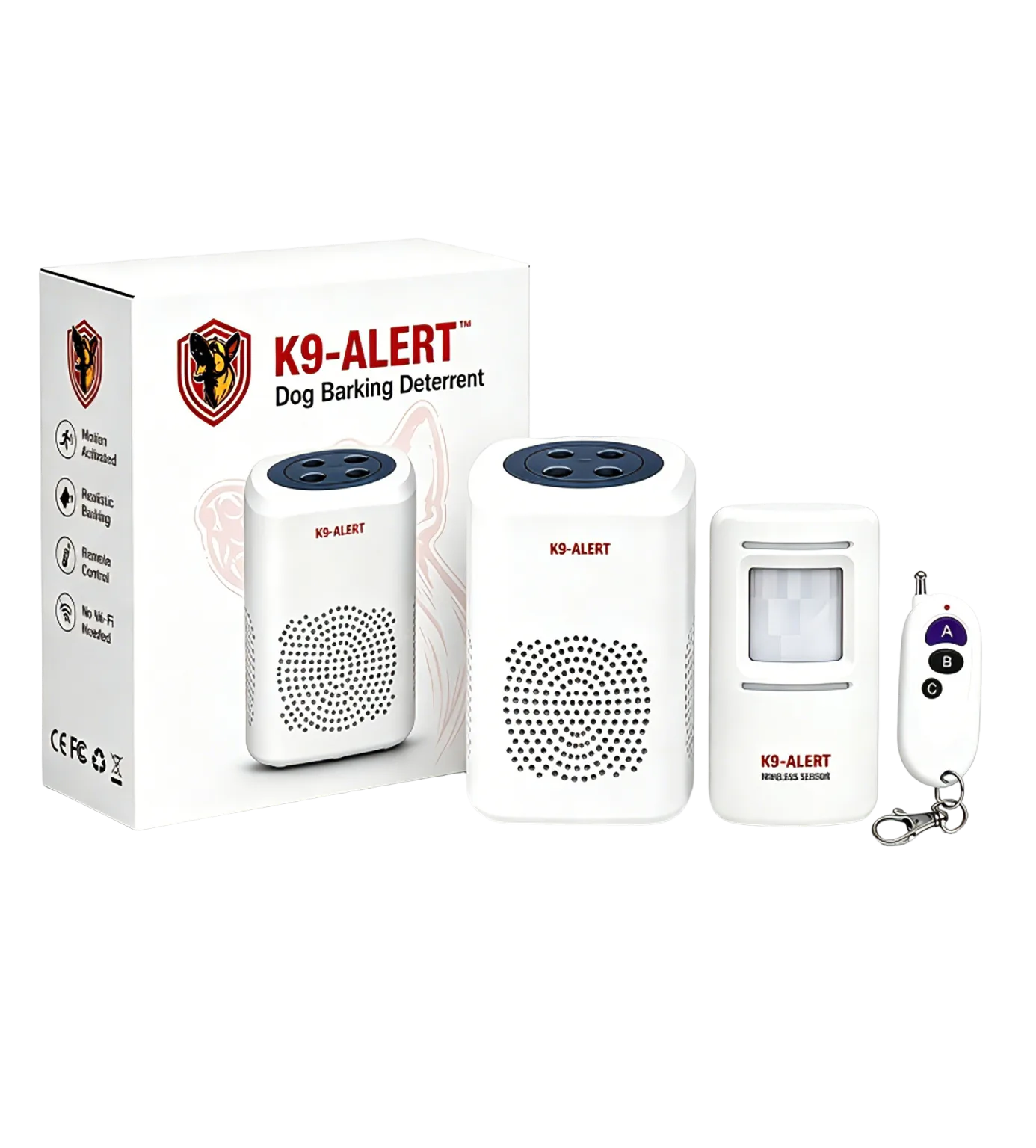
Put the sensor where your pets cannot go.
K9-Alert is a wireless PIR sensor and a receiver that plays up to 110 dB of barking when someone walks into a 110°, 0–7 m detection zone. It has no pet-immunity setting, so aim it at the front path, gate, driveway or inside the shed — and use the remote to disarm while pets share the area.
- Remote arm and disarm: switch the zone off when the dog is out front.
- Sensors up to ~200 m from the receiver in open space, so the bark can sound from inside the house.
- No Wi-Fi, app or subscription; up to 8 sensors per receiver.
This short demo shows the sensor detecting movement and the receiver barking, so you can judge the sound before deciding whether it suits a home with animals of its own.
Cover the approach your pets can’t reach.
K9-Alert watches the front path, gate, driveway or shed and answers movement with barking. It is a deterrent layer, not a monitored alarm, and it works best alongside locks, lighting and a sensor plan that keeps pets out of the zone.
Frequently asked questions
Will my dog set off a motion sensor alarm?
Usually, yes. A standard PIR motion sensor reacts to body heat moving across its view, and a dog produces plenty. Pet-immune sensors reduce this by ignoring animals below a weight rating, but the most reliable fix is placing sensors where your dog cannot walk or climb.
What weight do pet-immune sensors ignore?
It depends on the model. Bosch’s Blue Line Gen2 pet-friendly PIR, for example, is specified to ignore one or two pets up to 20 kg. A pet that climbs furniture, stairs or benches can still reach the detection zone, so compare the rating with your heaviest and most agile animal.
Can I use a barking dog alarm if I already have a dog?
Yes, if the sensor watches an area your dog cannot reach, such as the front path outside a fenced yard, the driveway gate or the inside of a locked shed. Disarm it with the remote while your dog is in that zone, and let your dog hear the sound calmly first.
Do cats and possums trigger outdoor motion alarms at night?
They can. Any warm, moving animal crossing a PIR sensor’s view may trigger it, so outdoor sensors see more false alarms than indoor ones. Aim sensors along a narrow path rather than open lawn, and keep your own cat in overnight, which the RSPCA supports.
Sources
- Animal Medicines Australia, Pets in Australia 2025 media release
- Bosch Security Systems, Blue Line Gen2 PIR Motion Detectors
- Australian Institute of Criminology, Reports of burglary by DUMA detainees in Western Australia
- Australian Bureau of Statistics, Crime Victimisation 2024-25
- Victoria Police, Preventing home burglaries
- NSW Police Force, Protect Your Home
- RSPCA Australia, Cat containment policy