
TL;DR: Garages are an easy, low-visibility entry point because the internal door and remote-control override are often left unsecured. Lock every garage entry point the same way you lock the front door, remove visible tools and remotes, add motion lighting, and place a no-Wi-Fi sound deterrent at the approach before relying on the roller door alone.

Why do garages get targeted?
Australian households reported 196,600 break-ins and 217,500 attempted break-ins in 2024-25 (ABS, 2026). Garages fit the same pattern that drives most opportunistic burglary: low visibility from the street, valuable contents, and an entry point that residents assume is already covered by the roller door.
That assumption is the problem. A roller door stops casual access, but it is not the only way into a garage, and a garage is frequently not the final target — it is the path into the rest of the house. An Australian Institute of Criminology study of active burglars found that visible deterrence and the risk of noise changed target choice more than locks alone (AIC, TANDI 489), which matters in a space most households leave dark, unlit and unmonitored.
With short winter daylight hours, garages sit unlit and unused for longer stretches in the early evening — exactly the window when an opportunistic approach is more likely to go unnoticed.
Where are the weak points?
Most garage security gaps come from treating the roller door as the entire system, rather than one part of it.
- The internal side door. Many homes never lock the door between the garage and the house, since it feels "already inside."
- The manual override. Roller doors with an external manual release can be forced or unlocked from outside if the lock is worn or missing.
- Remotes left in cars. A garage remote sitting in a car parked in the driveway gives access to the garage — and from there, the house — without touching the roller door at all.
- Windows and side access. Garages built with a side window or a separate access door are often the least-secured opening on the entire property.
Victoria Police's prevention guidance is direct on this point: residents should lock doors, windows, gates, sheds and garage doors as standard practice, not as an afterthought reserved for the front of the house (Victoria Police).
How do the main defence layers compare?
No single device covers every weak point above. The strongest setups combine a few layers that each cover a different gap.
Hardware on every entry
Deadbolt the internal door, fit a slide bolt or padlock on the manual override, and secure any side window or door the same way as the front door.
Remove the dark approach
A motion-triggered light over the roller door or side entry removes the low-visibility cover that makes a garage attractive after dark.
Deter before entry
A motion-triggered barking alarm signals an occupied space the moment someone approaches, before they reach a tool, bike or the internal door.
Remotes, keys and clutter
Keep remotes out of cars left outside, store spare keys away from the garage, and avoid leaving valuable tools visible through a window.
Locks and lighting reduce opportunity. A sound layer adds the deterrent cue that changes a burglar's decision before they commit to an approach — the same principle behind securing sheds and garages without permanent fixtures.
Where should a sound deterrent go in a garage?
Placement decides whether a motion-triggered garage alarm system actually catches someone before they reach the door, or only after they are already inside reach of a tool or the internal entry. The sensor should face the approach, not the open floor of the garage.
| Garage type | Best sensor position | Why it works |
|---|---|---|
| Attached, roller door | Cover the side door and the internal path, not just the roller | The roller door is the obvious entry; the internal door is the quiet one. |
| Detached garage or shed-garage | Mount under an eave facing the walk-up path | No power point or Wi-Fi is needed — battery sensors cover remote structures. |
| Carport or open bay | Aim at the entry to stored tools or the house-side door | An open bay has no roller door to slow anyone down at all. |
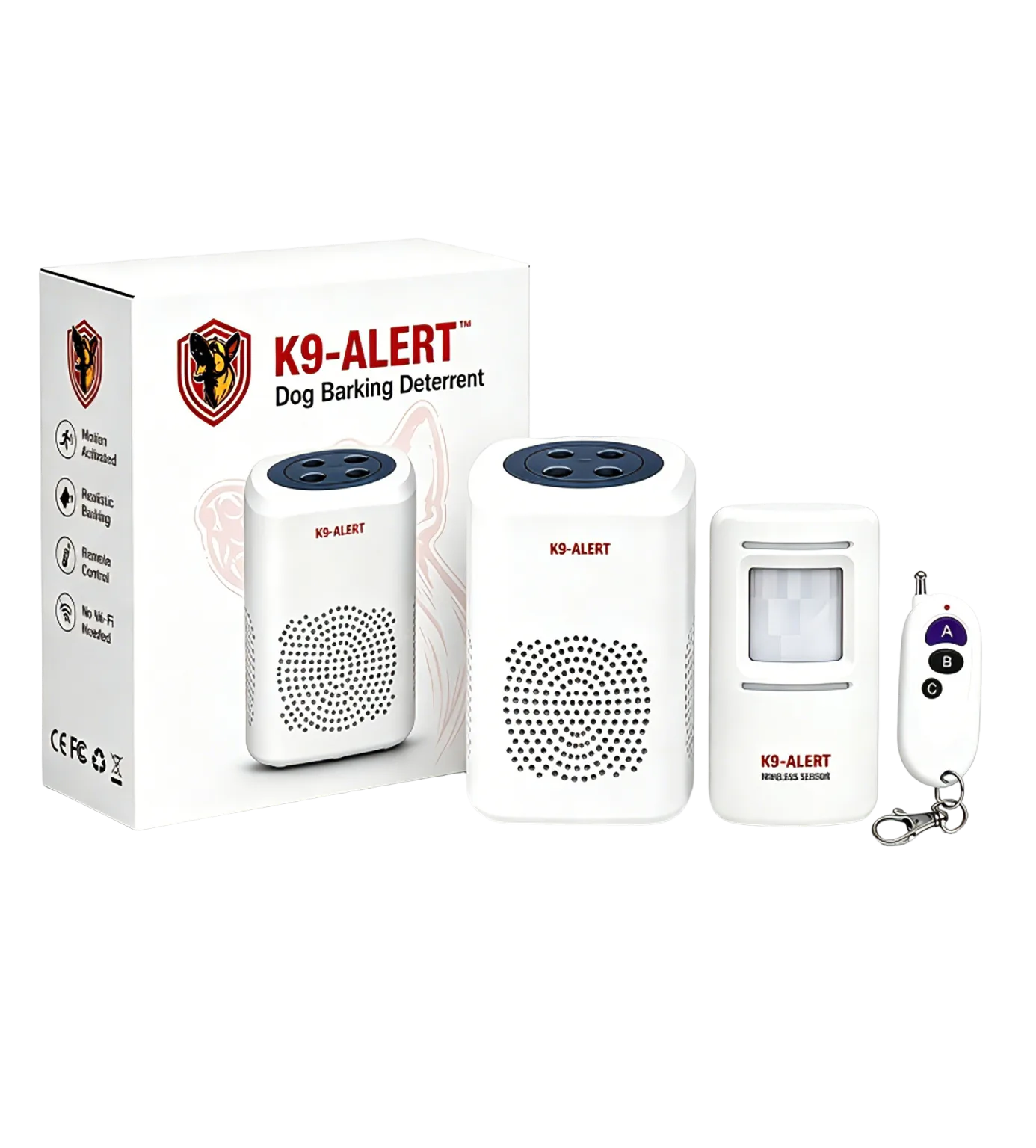
Add a sound layer to your garage in minutes.
K9-Alert is a motion-triggered barking dog alarm built for spaces without Wi-Fi or a nearby power point. Place the wireless sensor at the garage approach and the receiver inside, so the bark sounds like it comes from an occupied space.
- Battery or USB powered: works in detached garages with no power run.
- Arm and disarm by remote: no app, account or subscription required.
- Expandable: add a sensor for the side door as well as the roller door.
Garage security checklist
Work through this list in order. It starts with the weak points that get skipped most often, then adds the layers that make a garage a harder target than the house next door.
Secure your garage this weekend
- Lock the internal door between the garage and the house, every time — not just overnight.
- Check the manual override on the roller door and fit a slide bolt or padlock if it has none.
- Remove remotes from cars left in the driveway or on the street.
- Cover or frost any garage window that lets someone see stored tools or bikes from outside.
- Add motion lighting over the roller door and any side entry.
- Place a motion-triggered sound deterrent facing the approach, not the open garage floor.
- Store spare keys away from the garage, never on a hook near the internal door.
Make your garage a harder target.
K9-Alert adds a no-Wi-Fi barking response at the roller door, side entry or detached garage — no power point, app or subscription required.
Order K9-Alert · $99.95Frequently asked questions
What is the weakest point in most Australian garages?
The internal side door between the garage and the house, and the manual override on a roller door, are the two most common weak points. Both are often left unlocked because residents treat the garage as already secured by the roller door alone.
Should I lock the door between my garage and house?
Yes. Victoria Police advises locking doors, windows, gates, sheds and garage doors, and an internal garage door is frequently the only barrier left once a roller door has been forced or left open during the day.
Does a barking dog alarm work in a garage without Wi-Fi?
Yes. K9-Alert uses a battery-powered wireless motion sensor and a separate receiver, so it works in a detached garage or one with no power point or internet connection. It triggers a realistic bark when movement is detected near the protected entry.
Is a garage door sensor enough on its own?
No single device is a complete system. A door sensor or alarm works best alongside solid locks on every entry point, motion lighting outside, and keeping garage remotes and spare keys out of view.