
TL;DR: Rural property security must be deterrence-first, not response-first. When police are 40 minutes away and NBN doesn't reach the shed, the goal is to make your property a less attractive target before anything happens — not to alert you after it has. Battery-powered alarms, multiple sensors, visible deterrents, and physical hardening are the practical layers.
Why rural security is different
Most home security products are designed for suburban homes with reliable Wi-Fi, nearby police stations, and neighbours who might hear something. Rural and farm properties have different realities:
- Long police response times: in rural and remote areas, police response to a break-in can take 30–60 minutes or more. By the time police arrive, whoever broke in is long gone. This fundamentally changes the value of monitoring and response alarms.
- Unreliable internet: NBN coverage across rural Australia varies enormously. Fixed wireless and satellite services have dropouts. Outbuildings — sheds, barns, workshops — often have no network coverage at all.
- Large property area: a farm or acreage property has many entry points spread across a large area. A single alarm system at the house does not cover the machinery shed 300 metres away.
- High-value portable targets: quad bikes, tools, fuel, spare parts, and machinery accessories are frequently targeted. They are valuable, portable, and difficult to trace once sold.
The rural security principle: deterrence before response
In a city, a monitored alarm makes sense: police can respond in 10 minutes, neighbours hear the siren, and cameras provide useful evidence. In a rural setting, a monitored alarm is still useful for evidence and insurance, but its primary protective value — rapid response — is reduced.
For rural properties, the most effective security is deterrence: making your property a less attractive target than the next one. Deterrence works before the incident, not after. A thief who decides not to approach a shed because there is a motion alarm is a much better outcome than one who breaks in and gets away before police arrive.
The three deterrence signals that matter most:
- Noise: a bark alarm or siren at a shed door signals occupancy and risk. It draws attention and prompts a decision to abort.
- Light: motion-activated lighting at night removes the cover of darkness and signals a response to approach.
- Visible security: a padlock that requires an angle grinder, alarm signage, and a dog bowl near the house all signal "this is not an easy property."
Layered approach for rural properties
Layer 1: Physical hardening
- Hardened padlocks on all sheds and outbuildings: standard padlocks are cut in seconds. A shrouded, hardened-steel shackle padlock (Abloy Protec, Mul-T-Lock) requires significant time and effort to defeat.
- Secure fuel storage: fuel theft is extremely common on rural properties. A locked cage or cabinet around the bowser or drum rack, combined with a motion alarm, significantly raises the effort required.
- Chain valuable machinery to a fixed anchor: quad bikes, ride-on mowers, and smaller machinery can be chained to a wall anchor or buried post within the shed.
Layer 2: Battery-powered wireless alarms
The rural constraint — no power point, no Wi-Fi — requires battery-powered alarms that communicate wirelessly without internet. A motion-triggered barking dog alarm is particularly well-suited because:
- The sensor runs on batteries — no power point needed at the shed or outbuilding.
- The sensor communicates wirelessly with the receiver via radio frequency — no Wi-Fi, no NBN, no mobile signal needed.
- Multiple sensors can be paired to one receiver in the house — every outbuilding feeds the same alert point.
- The bark cue signals occupancy, which is a stronger deterrent than a generic siren in a remote location where no one will hear it anyway.
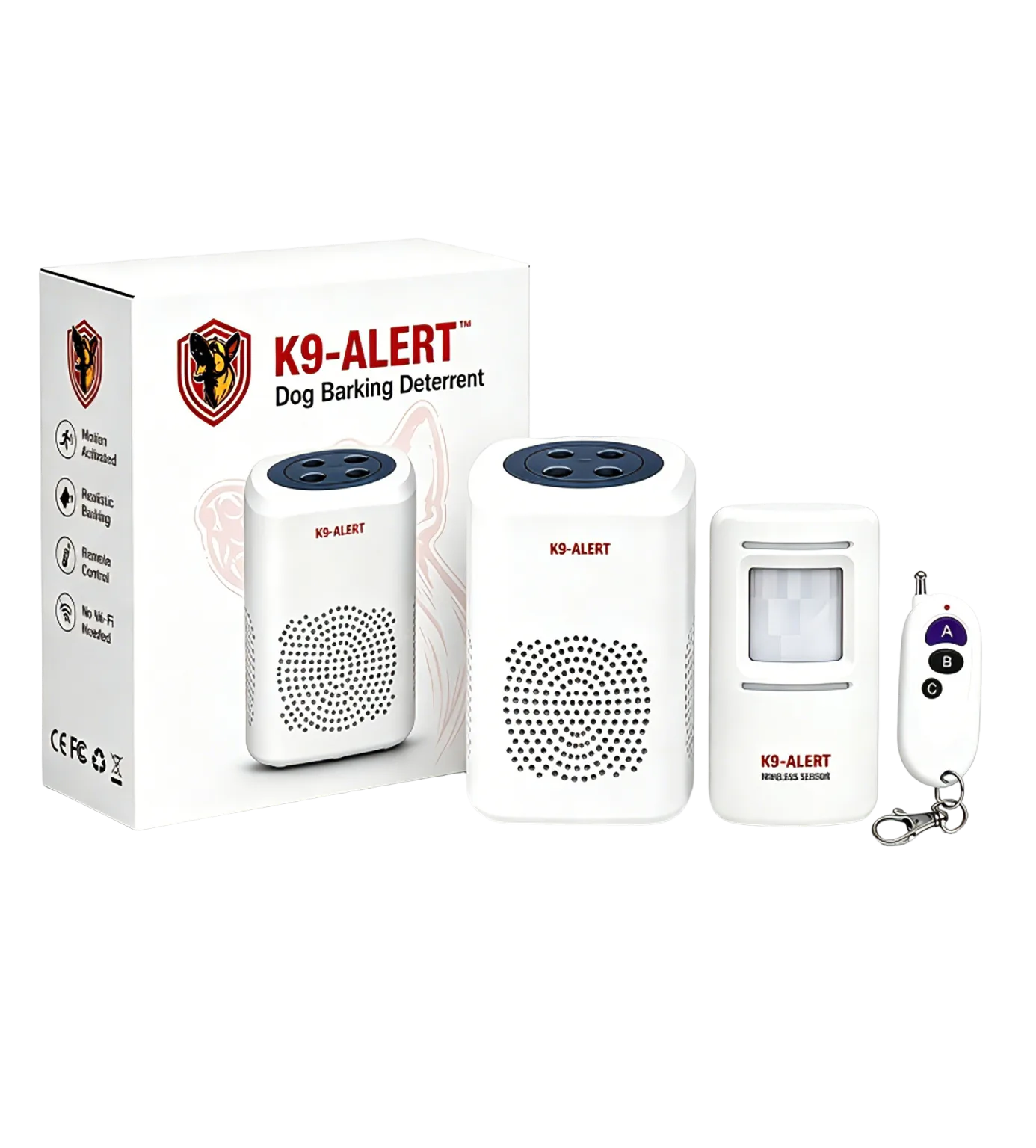
K9-Alert: works without Wi-Fi, scales across outbuildings
K9-Alert is battery-powered at the sensor and communicates wirelessly without internet. Add multiple sensors to cover each outbuilding — all feeding the same receiver in the house.
- No Wi-Fi needed: direct radio-frequency link, no NBN, no mobile data.
- Battery sensor: no power point required at the shed or outbuilding.
- Multiple sensors: scale across house, shed, barn, workshop and fuel storage.
- Key fob arm/disarm: one button to arm before you leave the property.
Layer 3: Lighting
- Solar-powered motion lights: no wiring needed, work off-grid, effective deterrent at night. Position them to cover the approach to each shed and the house entry.
- Dusk-to-dawn light near the main shed: a permanently illuminated yard around the machinery shed removes the darkness cover that enables opportunistic theft.
Layer 4: Cameras and recording
Cameras are valuable on rural properties — primarily for evidence after the fact and for insurance claims. The constraints are the same: they need power and Wi-Fi for cloud storage. Options:
- Solar-powered cameras with local SD card storage: no power or internet needed. Footage is stored locally and can be reviewed manually. Brands like Reolink, Eufy, and Swann offer solar models.
- 4G/LTE cameras where signal exists: in areas with mobile coverage, a 4G camera sends footage via the mobile network rather than Wi-Fi.
Protecting specific rural targets
Motion alarm + hardened padlock + lighting
Battery-powered motion sensor at the door. Hardened padlock on the main entry. Solar motion light above the door. High-visibility alarm sticker.
Locked cage + motion alarm
Cage or cabinet lock on the bowser or drum rack. Motion alarm positioned to trigger on any approach to the fuel area.
Quality deadbolts + dog cue + motion alarm
Deadbolts on all external doors. Dog bowl or lead visible near entry. Motion alarm at front and back door approach. Motion-activated lighting.
Garage/shed storage + chains + alarm
Store quad bikes, ATVs and high-value equipment inside a locked shed overnight. Chain to a fixed anchor where possible. Motion alarm at the shed door.
Protect your property — even off the grid.
K9-Alert is a battery-powered wireless alarm that works without Wi-Fi or NBN — ideal for rural properties, farms and remote outbuildings. A$99.95 with free AU shipping.
Order K9-Alert · $99.95Frequently Asked Questions
What security measures work best for a rural property in Australia?
For rural properties, the most effective measures are deterrence-first rather than response-first. Physical hardening (quality locks, padlocks on sheds), visible deterrents (motion lights, dog cues, alarm signage), noise alarms that work without internet (battery-powered motion-triggered alarms), and robust physical security on the most valuable locations. Response-based security is limited by slow police response times and unreliable NBN in rural areas.
How do I secure farm sheds and outbuildings without power points or Wi-Fi?
Use battery-powered wireless alarms. The K9-Alert sensor is battery powered and communicates wirelessly with the receiver — no power point or internet connection needed at the sensor location. This makes it practical for remote sheds, barns, fuel storage and machinery bays that have no mains power.
See the barking dog alarm in action
Product claims are easier to judge when you can hear the device. This short demo shows the K9-Alert barking dog alarm detecting movement and playing realistic barking, so you can assess the sound before deciding where it fits in your home, garage, shed or rental.