
TL;DR: The best caravan security combines passive deterrents (visible locks, occupied-looking van), noise deterrents (bark alarm or siren), and habit-based discipline (never leave valuables visible, always lock up). The critical constraint off-grid: whatever alarm you use must work without a phone signal, Wi-Fi, or mains power.
The caravan theft problem in Australia
Caravan theft and break-ins spike during Australian holiday periods — particularly Christmas–New Year, Easter, and school holidays. Opportunistic thieves target caravan parks and free-camping areas looking for unlocked annexes, unattended bikes, outdoor furniture, tools in external storage bays, and vans left empty while owners are at the beach or town.
The research is consistent: most caravan break-ins are opportunistic. The thief was not specifically targeting your van; they were doing a quick scan of what was accessible. That means deterrence — making your van look like more trouble than it is worth — is the most effective strategy.
The off-grid constraint: why most alarms fail
Before you buy a caravan alarm, understand the constraint that eliminates most consumer security products:
Smart alarms don't work
Ring, SimpliSafe, and any cloud-connected security system requires a home Wi-Fi network or paid 4G/LTE data plan. Free campsites and national parks have neither.
App notifications useless
Even if you have a data SIM, remote campsites in the Outback, national parks, and coastal free-camps often have no mobile coverage. Push alerts cannot reach you.
Mains-dependent alarms excluded
Unless you are on a powered site, any alarm that needs a 240V supply is ruled out. You need something that runs entirely on standard AA or AAA batteries.
Must move site-to-site
Unlike a home, your van moves. A good caravan alarm takes minutes to set up and pack down, with no drilling, no adhesive permanently bonded to a surface you don't own.
Layered caravan security: what to use
1. Visible physical deterrents (first layer)
The easiest wins are things a thief notices from a distance and decides your van isn't worth the effort:
- Hitch lock — covers the coupling to prevent the van being towed away at night.
- Wheel clamp or boot — heavy, visible, and immediately signals your van is harder to steal than an uncluttered one nearby.
- Quality padlocks on external storage bays — cheap padlocks are cut in seconds; a hardened-steel shackle padlock is not.
- Annex zip ties or security clips — not for physical strength, but to make the annexe entrance look deliberate rather than casual.
2. Noise deterrents (second layer)
Physical locks stop theft of the van itself. For the annexe, external gear, and break-in attempts at the van door, a noise alarm is the deterrent. The goal is to create sudden, startling noise that prompts the thief to abort and move on.
A motion-activated barking dog alarm is particularly effective in a caravan context because:
- It runs on standard AA batteries — no mains power, no 12V hookup required.
- The wireless sensor communicates with the receiver without Wi-Fi or a phone signal.
- The sensor can be positioned outside (pointing at the annexe entrance, door, or storage bay) while the receiver and speaker sit inside the van.
- A barking sound reads as "someone is in there" — a more convincing occupied-home cue than a siren, which can simply be a car alarm false trigger.
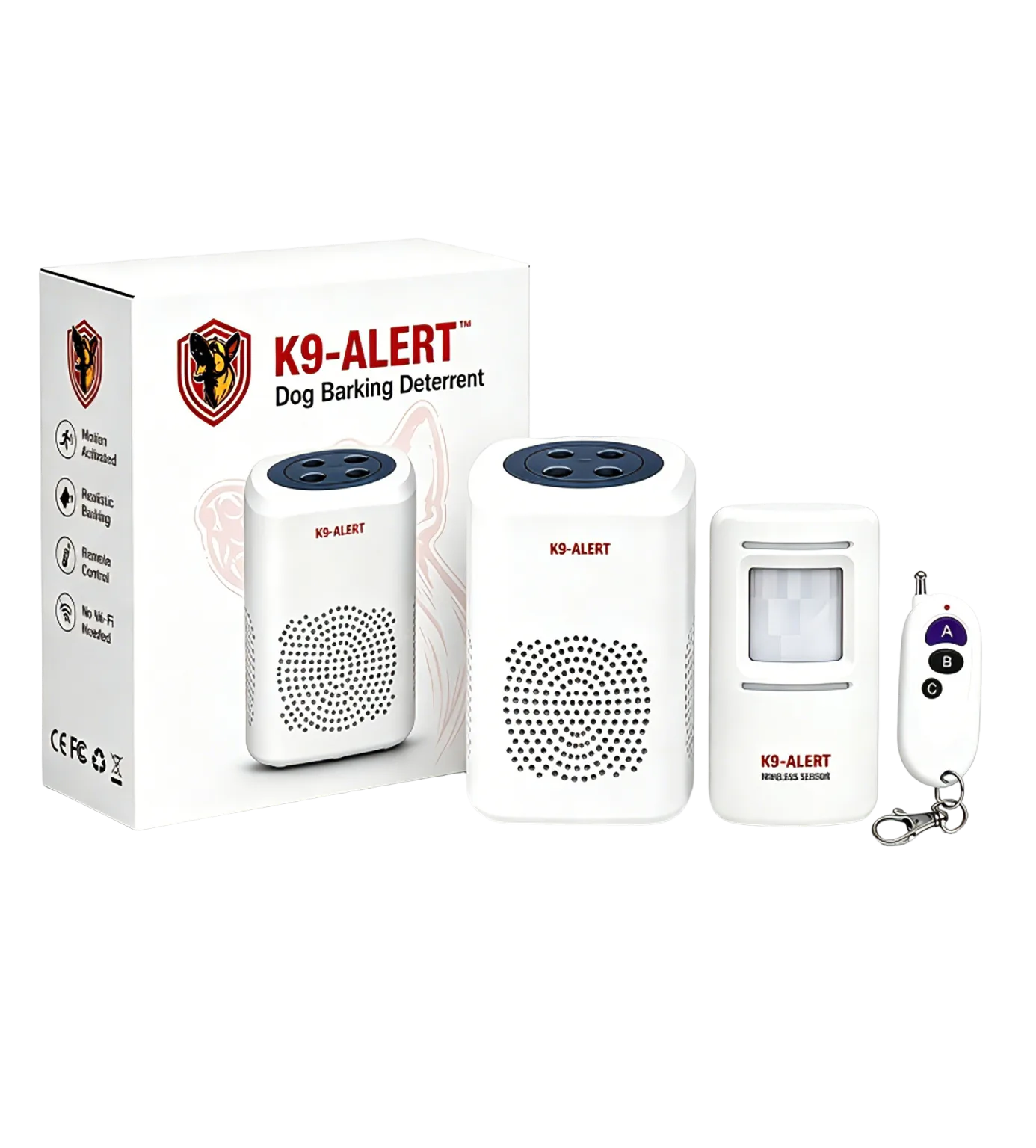
K9-Alert works anywhere — no Wi-Fi needed
K9-Alert is a motion-triggered barking dog alarm that runs entirely on batteries and communicates wirelessly between sensor and receiver. Set it up at any campsite in minutes. No phone signal required. No subscription. No installation.
- Battery powered: standard AA batteries, no mains hookup or 12V connection needed.
- Wireless sensor range: up to 200 m line-of-sight, less through walls — position outside to cover annexes and door areas.
- Key fob arm/disarm: one button to arm when you leave, one button to disarm when you return.
- Multiple sensors: add additional wireless sensors to cover multiple access points.
3. Habit discipline (third layer)
No alarm replaces good habits. The habits that make the most difference:
- Never leave bikes, chairs, or outdoor gear outside unattended overnight — loose outdoor gear is the easiest opportunistic target.
- Keep valuables out of sight inside the van — items visible through windows invite the look-and-grab.
- Lock external storage bays every single time — the one time you don't is the time a thief walks past.
- Arm the alarm every time you leave site — a key fob remote makes this a 1-second habit.
Protecting the annexe specifically
The annexe is the softest target on a caravan setup. It's fabric, it zips, and it typically contains camping chairs, a portable BBQ, outdoor toys, and sometimes a portable generator or fridge. Here's how to address it specifically:
- Run the wireless motion sensor cord or stand just inside or directly above the main annexe zip entrance — any approach to open it triggers the bark alarm inside the van.
- Secure annexe poles and frame sections with a cable lock threaded through them to something immovable — this won't stop theft, but it slows it and makes packing down the annexe take longer than a thief wants to spend.
- Store the most valuable items (generator, portable power station, expensive camp gear) inside the van overnight, not in the annexe.
Comparison: caravan alarm options
| Type | Works off-grid | Deters approach | Notes |
|---|---|---|---|
| Wireless bark alarm (K9-Alert) | Yes — battery only | Strong — "someone's home" cue | Sensor covers door or annexe; arm via key fob |
| PIR siren alarm | Yes — battery | Moderate — loud but generic | Often mistaken for car alarm; neighbours may ignore |
| Smart camera (Ring, Arlo) | No — needs Wi-Fi | Weak — records, rarely deters | Useless at remote campsites without signal |
| GSM alarm | Partial — needs mobile signal | Moderate | Unreliable in Outback, national parks |
| Hitch lock + wheel clamp | Yes — passive | Strong — against tow-away | Physical layer only; does not cover break-in |
Protect your van at every campsite.
K9-Alert is a battery-powered, wireless barking dog alarm that works off-grid — no Wi-Fi, no subscription, no installation. A$99.95 with free AU shipping.
Order K9-Alert · $99.95Frequently Asked Questions
What is the best security alarm for a caravan in Australia?
The best caravan alarm is wireless, battery-powered, and works without Wi-Fi or a phone signal. A motion-activated barking dog alarm like K9-Alert is effective because it runs entirely off standard batteries, requires no network connection, and triggers a deterrent bark sound the moment movement is detected near your van's entry point — even at a remote campsite hundreds of kilometres from the nearest town.
Can I use a home alarm system in a caravan?
Most home alarm systems are designed for fixed installations with mains power and a permanent internet connection. In a caravan you need something self-contained. A wireless alarm that runs on batteries, requires no hub, and can be moved from site to site is the practical choice.
How do I secure my caravan annexe?
Point the wireless motion sensor toward the annexe entrance. Because the K9-Alert sensor has a wireless range of up to 200 m line-of-sight, less through walls, and communicates wirelessly with the receiver inside the van, you can position it outside to cover the annexe zip-up door, awning area, or any external storage compartment — and the bark alarm will activate inside when movement is detected.
Are caravans frequently broken into in Australia?
Caravan parks and remote campsites can attract opportunistic thieves targeting unlocked vans, outdoor gear, bikes, and annexe contents. Popular holiday periods such as Christmas and Easter are the highest-risk times. Visible deterrents — including noise alarms and ensuring the van looks occupied — are the most effective countermeasures.
See the barking dog alarm in action
Product claims are easier to judge when you can hear the device. This short demo shows the K9-Alert barking dog alarm detecting movement and playing realistic barking, so you can assess the sound before deciding where it fits in your home, garage, shed or rental.