
The main house is dark, but someone is still awake in the granny flat. A guest comes through the side gate and walks towards the wrong door. No one agreed who should close that gate, where parcels belong or who controls the light above the path.
Granny flat security in Australia starts with that shared space. Treat the flat as a home in its own right and plan how its entrance connects to the main house. The advice covers a lived-in dwelling on a shared site, with privacy and access needs distinct from an empty garden room or storage shed.
TL;DR: Give the granny flat its own entry checks, clear visitor route and safe way out. Agree who handles the shared gate, lights and parcels. If you add a sound device, check it against both homes’ daily routines. Sound is one layer; it does not replace locks or a plan for help.

Why does granny flat security need its own plan?
A granny flat needs its own plan because the person who lives there may use a different door and keep different hours from the main household. Start with their entrance, daily needs and private space. Agree what both homes share, then give each task a named owner instead of leaving it to chance.
What does research say about easy entry?
A 2014 Australian Institute of Criminology study of adult WA detainees reported:
- 66.2% typically entered through unlocked doors or windows.
- 57.8% described their burglaries as unplanned.
- 29.0% of target-choice responses cited valuables in view.
- 46.2% would enter an occupied property if they thought they could steal unseen.
The interviews took place in 2012; 69 adults with recent self-reported burglary were included. Question response bases varied. These are historical self-reports, not current national rates or granny-flat risk estimates.
The practical starting point is the flat’s own door. Do not skip its closing check just because someone is in the main house. Ask the person who lives there to show you the route they use, and which doors and windows need repair.
Put the whole route on paper
Sketch the street entrance, gate, shared path and each home. Mark where a guest should wait before they reach private space. Queensland Police’s home guidance (2023) takes this outside-in approach; choose the parts that need work, rather than changing every layer.
Decide whether you want a sound at the entrance, a phone alert, video or a monitored response. These functions serve different needs, so compare each feature with the response you want at the flat’s entrance. A camera can help deter and record activity, as Victoria Police’s CCTV guidance explains, but check its actual features rather than assuming it provides every type of response.
How should you secure the path and the flat’s entrance?
Check the full path from the street to the flat, then inspect the door and windows of the flat itself. Make it clear where guests should stop and where parcels go. Look for faults that need repair before you choose extra gear, and keep the route easy for both households to use.
Check the door and window locks
Close the flat’s outer door as you would each day. Try the latch and lock, then inspect the hinges and frame for visible damage that needs professional repair. Include any other door used to enter the flat, even one that opens towards the main house.
Ask the person who lives there to show how each window closes and locks. Record any part that sticks or will not engage rather than forcing it, then ask the authorised repair contact to arrange an assessment. Send a short fault list, with photos if useful, to the person who can arrange repairs.
Check the shared gate and path
Walk the route in daylight and after dark. Check whether a first-time guest can find the right door without walking past private windows or stepping around bikes and bins. Victoria Police’s home guidance, updated in 2026, advises locking gates and keeping the boundary clear.
Use the side-gate security checklist for the latch and hinges. Try the gate while carrying your usual bags. Agree a waiting point for guests and a parcel spot that fits the rule for closing the gate.
Check how the light falls from both homes before adjusting its direction, particularly near bedroom windows and the shared path. For a path through a larger yard, the backyard security guide covers the wider boundary. Keep this plan focused on the route to a lived-in home.
Who should control keys, visitors and repairs?
Give each shared task a named contact, while keeping the flat’s private entry routine with the person who lives there. Discuss keys, guests and repairs before purchase, so the arrangement works for both households. Use the table as a draft household plan to agree together; it does not decide tenancy rights or give anyone permission to enter another home.
| Task | Who agrees the plan? | What to record |
|---|---|---|
| Shared gate | Both households | Closing routine and contact for faults |
| Flat keys | The flat’s resident and chosen key holder | Who has a key and what to do if it is lost |
| Path light | Person who can arrange repairs | Who reports a fault and follows it up |
| Guests and parcels | Each household for its own guests | Waiting point and contact details |
| Sound device | Person who will use it | Place, settings and power checks |
| Help while away | Resident and chosen helper | Agreed tasks and any access needed |
A shared-entry plan you can fill in
Copy or download this printable shared-entry plan and complete it with the flat’s resident. Keep personal contact details privately. The plan records agreed tasks; it does not grant access, change a tenancy or turn the main household into a monitoring service.
| Write down | Your agreed arrangement |
|---|---|
| Flat entrance and visitor waiting point | Entrance: ______ Waiting point: ______ |
| Gate and light faults | Who reports: ______ Who arranges repair: ______ |
| Key access | Key holder: ______ Agreed reason and contact-before-entry: ______ |
| Different routines | Gate/sound arrangement for late arrivals: ______ |
| Sound and power checks | Receiver location: ______ Who tests: ______ Next check: ______ |
| Escape and meeting point | Resident can open the complete route: ______ Meeting place: ______ |
| Away help | Specific tasks, contact and return date: ______ |
| Unresolved issue | Action owner: ______ Due date: ______ Review date: ______ |
Keep a spare key’s purpose clear
Discuss why someone holds a spare key and how they should make contact before using it. A key kept for agreed help need not mean casual entry. Review the plan if someone moves in, changes work hours or no longer wants that help.
For a rented flat, check the tenancy agreement and your state’s tenancy advice before changing locks or fixtures. Do not assume a family member’s consent settles it. The guide to renter security without drilling can help you list options to discuss.
How can both homes keep different schedules safely?
Plan a separate arrival and leaving routine for each home, then check how they meet at the shared gate. Someone being home next door should not replace the flat’s own lock checks. Share only the details needed for an agreed task, such as taking in a parcel while the flat’s resident is away.
What did our route comparison find?
For this guide, we drew the example layouts below and traced each home's normal route from the street. We marked shared points, private branches and the flat's way out, then checked who would pass each point during an ordinary arrival. This is a desk exercise using the drawn paths, not a property visit or sensor test.
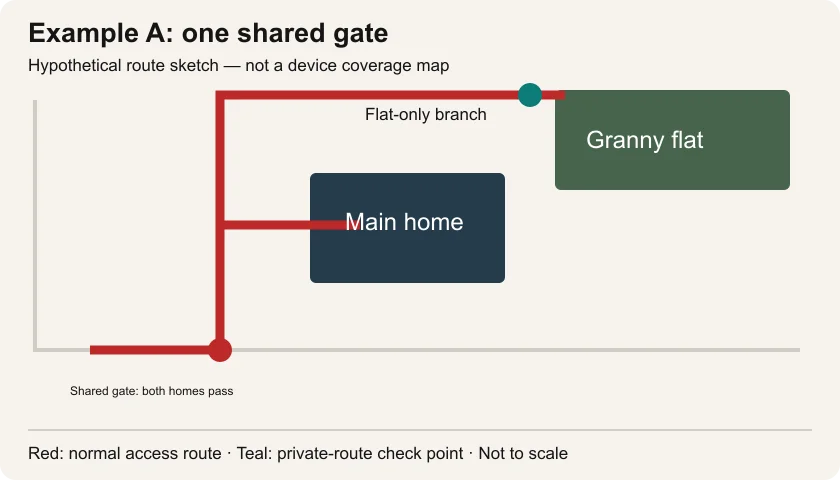
In the shared-gate drawing, a check at the gate includes both homes' arrivals. Moving the check to the flat's branch removes the main home's drawn route. That changes whom you need to consult about normal triggers; it does not prove where a real sensor will detect movement or how far sound will carry.
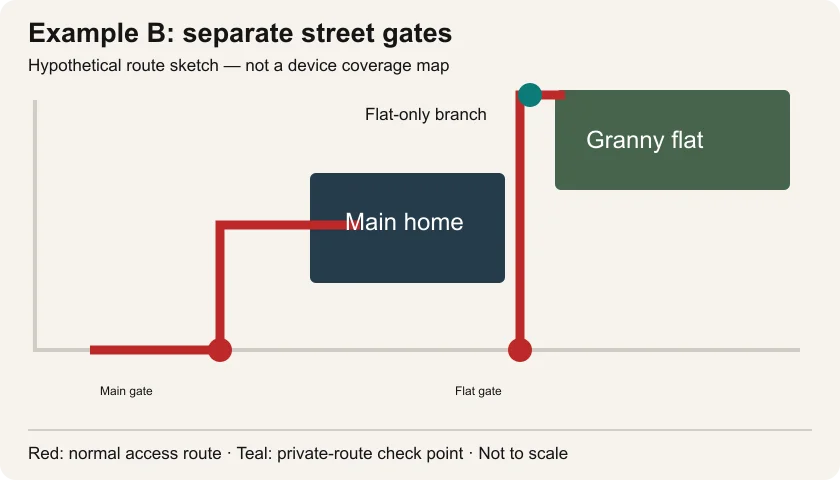
The separate-gate drawing shows why one rule will not fit every site. Copy the sketch method with your own doors and daily trips, then walk the actual path and check device instructions. Keep visitors' waiting points, bin trips and the way out in the plan; real walls, terrain and daily use can change the result.
How do you improve security without blocking escape?
Check how the person gets out before you add a lock, gate or other barrier. Follow the route from inside the flat through the shared yard. Keep it clear, and ask for skilled advice when a change could make escape harder. Plan for the needs of the person who will use that route.
Fire and Rescue NSW’s home escape guide (source checked 20 October 2026) calls for clear exits and a plan that takes account of children, older people and people with disability. Include the flat as its own home when you discuss a way out and a meeting point.
Walk beyond the flat’s door
Trace the route from the sleeping area to the agreed outdoor meeting place. Include the shared gate. Can the person in the flat open it on their own, without help from someone in the main house?
Before fitting a latch, show the installer the whole route and explain who uses it. Ask how the new lock opens from inside. Do not add a chain simply because it looks strong without checking how someone would leave.
Check key storage and exit needs together
Victoria Police advises against hiding spare keys outside and says to unlock deadlocks while inside for fire escape. Fire and Rescue NSW stresses quick exit access. Ask a locksmith and local fire service how to meet both needs with your doors, rather than copying a rule that may not fit.
If a break-in is in progress or someone is in immediate danger, follow Victoria Police’s emergency advice: get to safety, avoid confronting the intruder and call Triple Zero (000). Do not send someone from the main house down the path to check.
Can a local sound device suit a granny flat?
A local sound device may suit the flat when you want a sound near its entry without using the main house’s internet. First decide where it should respond and check whether arrivals, deliveries or bin trips would trigger it. Keep locks, lights and safe exit checks in the plan; a sound does not promise that a person will stop.
Choose the job, then the device
In the AIC study published in 2014, nominated deterrents included dog presence (61.4%), working alarms (49.1%), sensor lights (22.8%) and gates (12.3%). These overlapping responses do not measure crime reduction or test recorded barking, and should not be added together.
The guide to home alarms without Wi-Fi explains local sound and remote features. Working without Wi-Fi does not, on its own, mean a device sends phone alerts or contacts police.
See the setup process
The setup guide below explains product installation. It is not a test in a granny flat or proof of crime prevention. Use it to understand the setup process, then check the proposed placement and sound with both households before use.
For this separate-home layout, place the sensor on the flat’s private approach under shelter, with the receiver indoors. Check the radio link through the actual walls and agree sound levels with both households; the published open-space range is not a promise through brickwork (current product specifications, 2026).
If local barking fits your plan, check the barking deterrent and its limits. It works without Wi-Fi or a subscription, but does not send phone alerts or contact police.
Which granny flat security checks should you finish tonight?
Start with a clear route, a closing routine and a way to report faults. Both homes should know how the plan works before you add extra gear. Use the suggested steps below to assign tasks after a shared walk-through, with urgent repairs taking priority over items that can wait for advice or consent.
| When | Do | Do not |
|---|---|---|
| Right now | Agree the flat’s entry and where its guests wait. | Assume each visitor belongs to the main house. |
| Tonight | Walk the path, close the gate and check the way out. | Add a barrier before checking escape. |
| Tomorrow morning | Assign fault reports and seek advice on repairs. | Treat a draft household plan as legal consent. |
| Before the next night | Check agreed changes against both homes’ routines. | Assume local sound provides remote monitoring. |
Ask the person in the flat to describe a normal trip home. If it needs a special exception each night, revise the plan. Keep the note where both homes can find it and set a time to review unresolved faults.
Make help while away specific
Victoria Police’s 2026 guidance suggests timers for lights and help with mail or bins when a home is empty. Agree which tasks apply to the flat. Someone who takes in the main house’s mail may not know to check a parcel by the flat.
“Please collect parcels from my agreed spot while I’m away” gives a helper a clear job. “Keep an eye on everything” leaves them to guess. Decide whom they should contact if they see damage; do not give them a patrol or confrontation role.
After a change in work hours, review the gate routine and any device settings. Tell the other household what has changed about shared access without asking either person to account for all their private movements.
What else should you know about granny flat security?
Keep the flat’s private entrance distinct from shared tasks at the gate and path. These answers can help you start that talk with the other household. Check the actual site before making changes, and ask for advice where locks, rental consent or safe escape affect the choice of what to do next.
Does a granny flat need separate security if someone is home in the main house?
Yes. Give the flat its own entry checks even when someone is often home next door. Agree how its doors, shared gate and visitor route work for the person who lives there. Someone in the main house may not hear the flat’s entrance or know whether its door is locked.
Can you use an audible deterrent without the main house’s Wi-Fi?
Yes, a local sound device built to work without Wi-Fi can make its sound without joining the main home’s network. Check its power, placement and use instructions first. Local sound does not mean a phone alert, police contact or a promise that someone in the other home will hear and respond.
How can shared security respect the granny flat resident’s privacy?
Agree the shared tasks: gate access, light repairs, guest directions and whom to call for help. Ask the person in the flat which private spaces and routines matter to them. Discuss cameras, sound devices and spare-key use before adding them, and check consent rather than assuming the shared site gives free access.